
 A.A.M. Auxiliary Assumption Method the
5th Pillar of GrowthOD 📞 Book a
GrowthOD Consultation -
A.A.M. Auxiliary Assumption Method the
5th Pillar of GrowthOD 📞 Book a
GrowthOD Consultation -
Voice: The
Scientific Clarifier
Full Pillar Name: Auxiliary
Assumptions Method
Who: Dr. David
Trafimow

Main Texts:
·
Trafimow, David. (2020). The role of
auxiliary assumptions
in scientific inference: Epistemological implications for
psychology. Review
of General Psychology, 24(2), 147–157. https://doi.org/10.1177/1089268020912075
·
Boje, D. M. (2025). AAM
Auxiliary Assumptions
Method 5th Pillar of Growth OD – Uncovering Invisible
Constraints in
Organizational Science and Practice. In
D. M. Boje &
Colleagues, GROWTH OD:
Gratitude-Rooted Organizational
Wisdom, Transformation & Healing (pp.
102–142). Las Cruces,
NM: Tamaraland Publishing. https://GrowthOD.org/AAM.html
Introduction:
Assumptions Are the Operating System
Every organization
runs on assumptions—about
success, about people, about data, about reality. These
assumptions are rarely seen. They are embedded in strategy
decks, policy handbooks, analytics platforms, leadership
philosophies, and even questions asked in coaching sessions.
There are Four
Auxiliary Assumptions:
1. Theoretical
assumptions are the
abstract principles proposed by a model or theory.
2. Auxiliary
assumptions link those
theoretical ideas to measurable realities.
3. Statistical
assumptions govern the
analytic procedures we employ (e.g., assumptions of normal
distribution, independence of errors).
4. Inferential
assumptions underpin the
logic we use to draw conclusions from data.
AAM
the Auxiliary Assumptions Method,
brings those assumptions into the light.
As The
Scientific Clarifier of GROWTH
OD, A.A.M. equips coaches, consultants, and leaders to apply the logic
of falsifiability and epistemic integrity to
their thinking. Based on the work of Dr. David Trafimow (2023),
A.A.M. is a breakthrough in organizational development and
social science—offering a rigorous
alternative to belief-driven interventions and unfalsifiable
models.
If you're a
practitioner of Organizational Development coaching or
consulting, Dr. David Trafimow's AAM is a mind-opening learning
experience. His Auxiliary Assumptions Method (AAM) offers the
missing link between strategy and epistemology. In a field
flooded with surface-level fixes and overconfidence in
personality tests or survey results, Trafimow's method asks you
to pause and examine the assumptions beneath your models. What are you taking
for granted about causality, data interpretation, or context?
With tools drawn from his rigorously peer-reviewed articles,
Trafimow equips you to articulate, test, and refine the
invisible scaffolding of your organizational claims. AAM
empowers you to coach leaders not just to act—but to think better, with humility and
logical clarity. This is what grounds GROWTH OD in scientific
integrity. It’s not about charismatic fixes, but principled
inquiry. And that’s why every serious consultant should start
their week with Trafimow. Find his tools on Google Scholar, in
top journals like British
Journal of Mathematical and Statistical Psychology, and
through your university library. Because real change starts with
better assumptions.
Where SEAM diagnoses
dysfunction, and AXIOGENICS guides value decisions, A.A.M. asks:
“What
assumptions are driving our conclusions—and are they testable,
entangled, or invisible?”
This pillar invites
organizations into intellectual humility, methodological
courage, and systemic honesty.
-
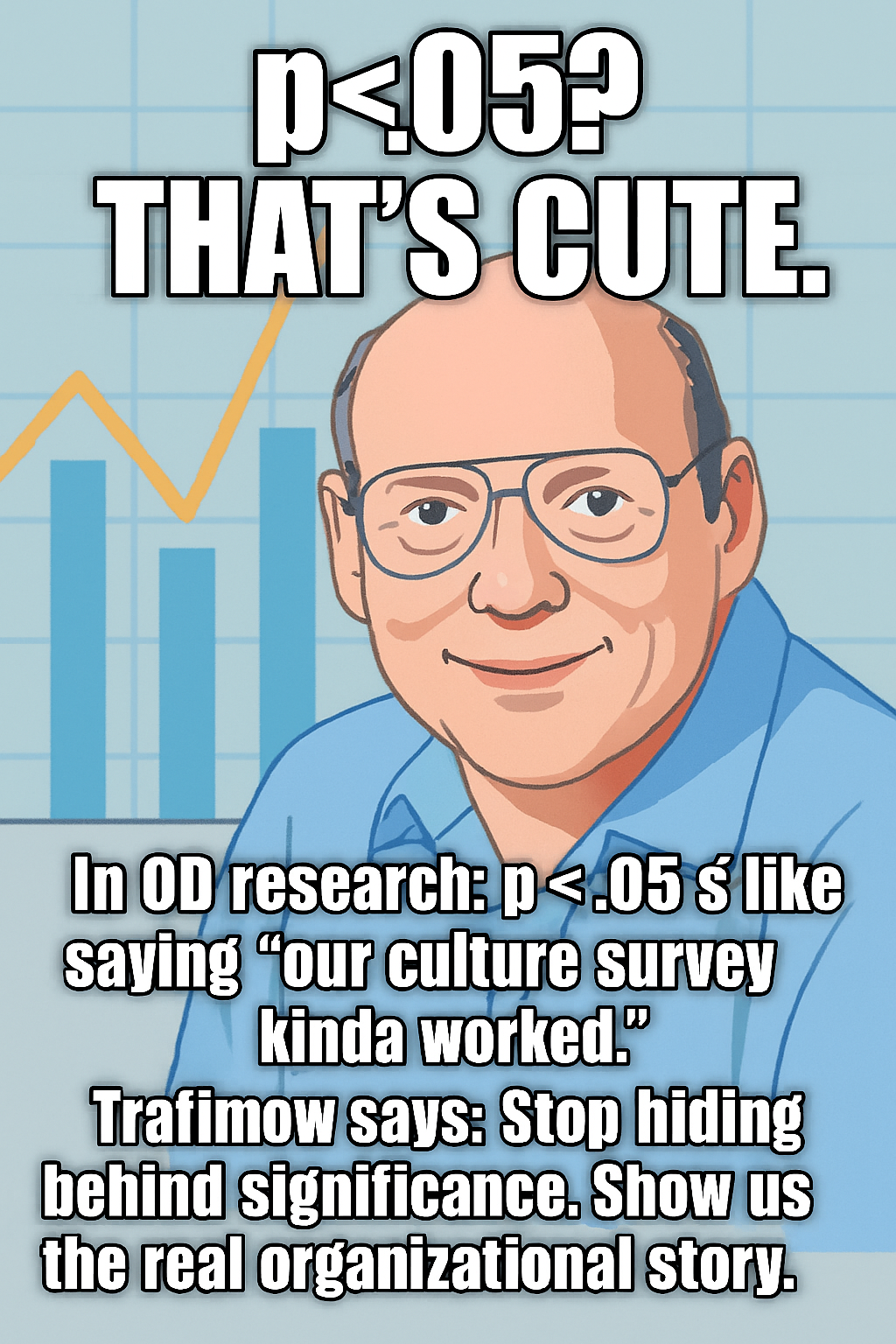
P-values have become a crutch for weak data: Trafimow and his co-editor stated that the commonly used threshold of p < .05 is "too easy to pass and sometimes serves as an excuse for lower quality research". This reliance on an arbitrary cutoff can encourage superficial analysis rather than deeper scientific understanding.
-
Invalidity of the process: Trafimow described NHST as "blatantly invalid," arguing that if scientists depend on such a process, it should be abandoned entirely. He would prefer no inferential statistics at all over using ones that are known to be problematic.
-
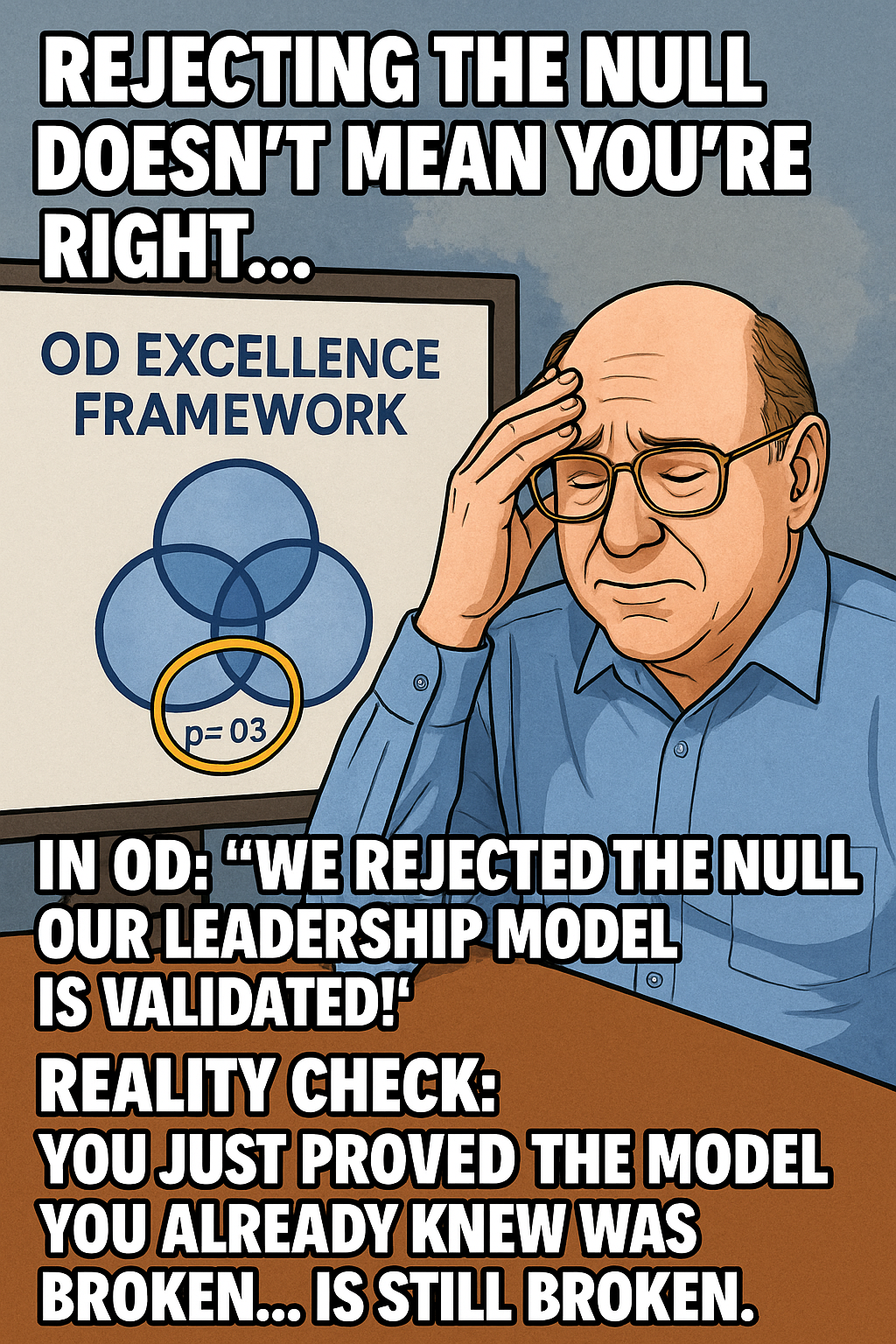
Misinterpretation of p-values: Many researchers mistakenly interpret a low p-value as strong evidence against the null hypothesis or as proof that the null hypothesis is false, which is incorrect. P-values only indicate the probability of obtaining data as extreme as observed, assuming the null hypothesis is true—they do not provide the probability that the null hypothesis is actually false.
-
Testing against models known to be wrong: Trafimow points out that statistical models are almost never exactly correct in real-world research. Thus, using p-values to test against a null hypothesis embedded in such a model is uninformative: "since the model is wrong, in the sense of not being exactly correct, whenever you reject it, you haven’t learned anything. And in the case where you fail to reject it, you’ve made a mistake". At best, you learn nothing; at worst, you draw incorrect conclusions.
-
Historical context: Trafimow notes that experiments and hypothesis testing existed long before p-values were invented, suggesting that organizational development (OD) science can function without them.
As a result of these concerns, Trafimow, as editor of Basic and Applied Social Psychology, implemented a policy banning p-values, confidence intervals, and hypothesis testing from the journal, instead requiring descriptive statistics and effect sizes. He acknowledges that he does not know what statistical approach should replace NHST, but maintains that abandoning a flawed method is preferable to continuing its use.
In summary, Trafimow's position is that p-values and NHST do not
provide reliable, meaningful evidence and can mislead
researchers, so they should be abandoned in favor of more
transparent and descriptive approaches.
Seven Questions for
Dr. David Trafimow (see
Full Study Guide and References)
1. Why Does AAM Say
the Null Hypothesis Should Be Abandoned in OD?
Key Points to
Ask:
- What are the
limitations of the null hypothesis in Organizational
Development (OD)?
- How does AAM
critique the logic and utility of the null hypothesis in
real-world OD practice?
- What
alternative framework or approach does Dr. Trafimow
propose to replace the null hypothesis in OD research
and interventions?
Background:
AAM argues that the null hypothesis oversimplifies complex
organizational
realities and often ignores the auxiliary assumptions that
underpin any claim
or intervention. Trafimow advocates for a focus on
explicitly identifying and
testing these auxiliary assumptions, rather than relying
on a binary null
hypothesis framework.
2. Why Does the
P-Value Need to Be Abandoned in OD? What Can Replace It?
Key Points to
Ask:
- What are the
epistemological and practical problems with using
p-values in OD research?
- How does the
reliance on p-values obscure meaningful findings or
inflate the significance of trivial results?
- What
alternative inferential tools or reasoning does Dr.
Trafimow recommend for OD researchers?
Background:
Recent critiques highlight that p-values can mislead
researchers, especially
when used as strict thresholds for significance,
potentially masking clinically
or organizationally relevant effects. Trafimow
proposes
that researchers should instead focus on the plausibility
and explicit testing
of auxiliary assumptions, and consider Bayesian or hybrid
inferential
approaches.
3. Why Does Adding
More Variables to an OD Model Weaken Reliability and
Validity? What Is the AAM
Alternative?
Key Points to
Ask:
- How does model
complexity (adding variables) impact the reliability and
validity of OD models?
- What does AAM
recommend to ensure that models remain robust and
meaningful?
- How should
researchers balance model parsimony with explanatory
power?
Background:
Adding more variables can introduce more untested
auxiliary assumptions,
increasing the risk of model fragility and reducing both
reliability and
validity. AAM suggests explicitly identifying and
empirically testing each
auxiliary assumption, rather than indiscriminately
increasing model complexity.
4. Citations to
Three Recent OD Studies Using P-Values—How Would Trafimow
Critique Them?
|
Study & Citation |
Trafimow’s Likely Critique |
|
Khattak et
al. (2024), "Impact of Structural OD
Interventions on Organizational Performance in
Pakistan" |
Overreliance on p-values leads to overlooking
clinically meaningful effects; AAM would critique
the lack of focus on auxiliary assumptions. |
|
Sorkin et al. (2021), "A guide for authors and
readers ... on the proper use of P values" |
P-values are often misinterpreted; AAM would
call for explicit articulation and testing of
underlying assumptions. |
|
Alirocumab Outcomes Trial (2019), "Nominal
Significance, P Values ..." |
P-value thresholds are arbitrary; AAM would
emphasize the need to examine the assumptions
connecting data to theory. |
5. Citations to Three Recent OD Studies with
Theoretical
Assumptions—AAM’s Approach to Measurable Realities
|
Study & Citation |
Theoretical Assumptions |
AAM’s Proposal |
|
Khattak et
al. (2024), "Impact of Structural OD
Interventions on Organizational Performance in
Pakistan" |
Organizations are driven by rationality,
reality, and liberty |
AAM would require explicit auxiliary
assumptions linking these principles to observable
outcomes. |
|
Marshak & Grant (2008), "Organizational
Discourse and New OD" |
Change is continuous and socially constructed |
AAM would identify and test the auxiliary
assumptions that operationalize these abstract
principles. |
|
Olson & Eoyang (2001), Complexity in OD
(cited in Marshak & Grant) |
Organizations as complex adaptive systems |
AAM would convert these into measurable
realities by articulating and empirically testing
the linking assumptions. |
6. Citations to
Three Recent OD Studies with Unexamined Statistical
Assumptions—AAM’s
Challenges
|
Study & Citation |
Unexamined Statistical Assumptions |
AAM’s Challenge |
|
Christiano et al. (2021), "Statistical
Assumptions in Orthopaedic Literature" |
Regression models rarely check underlying
assumptions |
AAM would require explicit reporting and
empirical testing of all statistical assumptions. |
|
Khattak et
al. (2024), "Impact of Structural OD
Interventions on Organizational Performance in
Pakistan" |
Assumes normality and independence in critical
care data |
AAM would challenge the validity of inferences
if these assumptions are not justified. |
|
Sorkin et al. (2021) |
P-value use assumes correct model
specification |
AAM would scrutinize the auxiliary assumptions
that make p-values meaningful. |
7. Citations to
Three Recent OD Studies Violating Falsifiability—AAM’s Focus
on Auxiliary
Assumptions
|
Study & Citation |
Violation of Falsifiability |
AAM’s Critique |
|
Watts (2017), cited in Science Forum: "How
failure to falsify ... contributes to the
replication crisis" |
Under-specified hypotheses, not directly
testable |
AAM would require strong, testable auxiliary
assumptions for scientific progress. |
|
Marshak & Grant (2008) |
Constructionist models often lack disprovable
claims |
AAM would insist on making auxiliary
assumptions explicit and falsifiable. |
|
Christiano et al. (2021) |
Statistical models not tested for
falsifiability |
AAM would call for explicit tests of the
auxiliary assumptions that underpin inferential
claims. |
The
Scientific Roots of A.A.M.
In scientific
reasoning, Trafimow (2023) builds on Karl Popper’s idea of
falsifiability—the idea that scientific claims must be disprovable to
be valid. Trafimow’s method focuses not just on hypotheses, but
on the auxiliary assumptions—the
invisible premises that hold the whole system up.
Example: A manager
concludes, “Productivity is down because employees aren’t
motivated.”
The auxiliary assumptions might be:
· Productivity
is the best measure of motivation.
· Motivation
is an individual, not systemic, trait.
· Environmental
factors have not changed.
If even one of these
assumptions is false, the entire diagnosis may collapse. A.A.M.
helps you find these assumptions, name them, test them, and
rethink them.
A.A.M.
in Organizational Life
A.A.M. transforms how
we approach:
· Data:
What do our metrics assume is valuable? What are they blind to?
· Strategy:
What future do our plans assume is
likely, and why?
· Culture:
What stories do we tell about “how things work around here”—and
where do those stories come from?
· Research:
What premises shape our survey questions, focus groups, or
outcome measures?
Using A.A.M. creates a
culture of curiosity instead of
certainty—not to paralyze decisions, but to strengthen
them.
Four
Key Moves of A.A.M.
1. Surface
the Assumption
What beliefs must be true for your conclusion to be valid?
2. Make
the Assumption Testable
Is there a way to check, disconfirm, or challenge this belief?
3. Check
for Entanglement
Is this assumption tied to other unspoken beliefs (e.g., about
identity, culture, systems)?
4. Invite
Transformational Inquiry
What would become possible if this assumption changed?
Coaching
and Consulting with A.A.M.
Use A.A.M. when:
· A
client keeps hitting the same wall with different strategies.
· A
team is convinced “nothing will ever change.”
· Leadership
decisions seem data-driven—but the data feels biased or
incomplete.
· Culture
change efforts plateau due to unspoken norms.
Sample
Questions:
· What
do you assume is causing this challenge?
· What
has to be true for that conclusion to hold?
· How
might we disprove that assumption?
· What’s
the story behind this belief—and who benefits from it?
· If
we reversed this assumption, what might shift?
Organizational
Case Example: A.A.M. in Action
A major media company
experienced sharp Gen Z turnover. Leaders assumed younger
workers lacked loyalty. Using A.A.M., the OD team surfaced
assumptions:
· That
job stability was still a primary value.
· That
loyalty means tenure, not alignment with purpose.
· That
onboarding was sufficient to create engagement.
They discovered that
new hires were leaving due to poor
sensemaking rituals and lack
of peer coherence. The assumption wasn’t “wrong”
morally—but it was incomplete and
unfalsifiable as originally stated.
By shifting
assumptions, the organization redesigned onboarding to focus on
team belonging, story work, and value alignment. Turnover
decreased by 18%.
A.A.M.
in the GROWTH OD Ecosystem
· With
P.E.R.V.I.E.W.: Stories are built on assumptions.
A.A.M. helps test whether those stories are still serving.
· With
SEAM: Hidden costs often arise from hidden
assumptions. “Turnover is normal” is an assumption that needs
falsification.
· With
AXIOGENICS: The Central Question helps create value;
A.A.M. helps ensure the foundation of that value is logically
sound.
· With
G.L.O.W.: Even gratitude can be performative if
assumptions about emotional labor go untested. A.A.M. invites
depth.
Entangled
Assumptions: A Special Challenge
Trafimow emphasizes
that many assumptions are entangled—knotted
together with identity, power, or organizational memory.
Example:
A CEO believes
“Leaders must always project confidence.”
The entangled assumptions might include:
· Vulnerability
= weakness
· Uncertainty
= incompetence
· Emotional
expression undermines authority
Using A.A.M., a coach
might ask:
· Where
did this assumption originate?
· What
events, people, or cultural messages entangle it?
· Can
we isolate and test just one strand of this belief?
This unraveling
process doesn’t just clarify logic—it liberates
identity.
Integrating
A.A.M. into Practice
1.
Falsifiability Audits
Pick one organizational policy or strategic assumption. Ask: Can
this be tested? What assumption would falsify it?
2. Assumption
Mapping Workshops
In team retreats, chart the assumptions behind major goals.
Explore which are testable, which are sacred, and which are
historical.
3. Story-Fact
Check
In P.E.R.V.I.E.W. coaching, pause to ask: “What assumption is
this story built on? And is it still true?”
4. GLOW
Alignment Test
Use A.A.M. to explore if the gratitude practices in place are
built on trust, or assumption-based performance scripts.
Coaching
Prompts Using A.A.M.
· What
needs to be true for your theory to hold?
· What
would change if that weren’t true?
· What
are you assuming about people, systems, or time?
· How
could we design this idea to be falsifiable?
· What
assumption are you most afraid to test?
Final
Reflection: A.A.M. as Humility-in-Action
In a time of
polarization, noise, and data overload, A.A.M. doesn’t ask us to
know more. It asks us to question more
skillfully.
Where to Find Trafimow’s Methodological Tools for Auxiliary Assumptions
1. Key Publications by David Trafimow
Trafimow’s frameworks are articulated primarily in his peer-reviewed articles and book chapters. Here are the most relevant and accessible sources:
a. Generalizing across auxiliary, statistical, and inferential assumptions
-
Citation: Trafimow, D. (2021). Generalizing across auxiliary, statistical, and inferential assumptions. British Journal of Mathematical and Statistical Psychology, 74(2), 293–308.
-
Content: Provides a clear breakdown of how to identify, articulate, and generalize auxiliary assumptions in research.
b. Non Causal Theories and Using Auxiliary Assumptions to Handle Situation‐Specificity
-
Citation: Trafimow, D. (2022). Non Causal Theories and Using Auxiliary Assumptions to Handle Situation‐Specificity. Journal for the Theory of Social Behaviour, 52(1), 3–18.
-
Access: PhilPapers - Article Link
-
Content: Offers practical reasoning frameworks for applying auxiliary assumptions in social science research.
c. Meaning in life research: the importance of considering auxiliary assumptions
-
Citation: St Quinton, T., & Trafimow, D. (2022). Meaning in life research: the importance of considering auxiliary assumptions. The Journal of Positive Psychology, 17(1), 1–10.
-
Access: Taylor & Francis - Article Link
-
Content: Applies the auxiliary assumptions framework to a specific research domain, with step-by-step guidance.
2. How to Use These Tools
-
Step 1: Read the above articles to understand the distinction between theoretical and auxiliary assumptions.
-
Step 2: Use Trafimow’s logic:
-
Identify all assumptions (theoretical and auxiliary) underlying your hypothesis and methodology.
-
Articulate each auxiliary assumption explicitly.
-
Evaluate: For each, ask: “If this auxiliary assumption were false, would my test of the theory still be valid?”
-
Test: Where possible, empirically or logically test the plausibility of each auxiliary assumption.
-
-
Step 3: Use Trafimow’s syllogistic reasoning (see the 2021 article) to map how auxiliary assumptions connect your data to your theoretical claims.
3. Google Scholar and University Libraries
-
Google Scholar: David Trafimow’s Profile
Search for “auxiliary assumptions” within his publications for the most relevant works. -
University Libraries: Use your institutional access to download full texts if paywalled.
Summary Table
| Resource Type | Title & Link | What You’ll Find |
|---|---|---|
| Peer-reviewed | Generalizing across auxiliary, statistical, and inferential assumptions | Core framework and reasoning tools |
| Peer-reviewed | Non Causal Theories and Using Auxiliary Assumptions to Handle Situation‐Specificity | Practical application in social science |
| Peer-reviewed | Meaning in life research: the importance of considering auxiliary assumptions | Step-by-step case example |
| Scholar profile | David Trafimow on Google Scholar | Full list of relevant publications |
This pillar grounds
GROWTH OD in epistemic integrity. It invites a new kind of
leadership—not based on control or charisma, but on curiosity,
testability, and respect for complexity.
Boje, D. M.
(2025). AAM Auxiliary Assumptions Method 5th
Pillar of Growth OD –
Uncovering Invisible Constraints in Organizational
Science and Practice. In
D. M. Boje & Colleagues, GROWTH
OD: Gratitude-Rooted
Organizational Wisdom, Transformation & Healing (pp.
102–142).
Las Cruces, NM: Tamaraland Publishing. https://GrowthOD.org/AAM.html
Trafimow, D.
(2020). The role of
auxiliary assumptions in scientific inference:
Epistemological implications for
psychology. Review of General
Psychology, 24(2),
147–157. https://doi.org/10.1177/1089268020912075
Trafimow, D.
(2021). Generalizing
across auxiliary, statistical, and inferential
assumptions. British Journal of Mathematical and
Statistical Psychology, 74(2),
293–308. https://doi.org/10.1111/bmsp.12222
Trafimow, D.
(2022). Non causal
theories and using auxiliary assumptions to handle
situation-specificity. Journal for the Theory of Social
Behaviour, 52(1),
3–18. https://doi.org/10.1111/jtsb.12284
St Quinton, T.,
& Trafimow, D.
(2022). Meaning in life research: The importance of
considering auxiliary
assumptions. The Journal of
Positive Psychology, 17(1),
1–10. https://doi.org/10.1080/17439760.2021.1940252
Key Methodological
and Theoretical Sources
Boje, D. M.
(2025). AAM Auxiliary
Assumptions Method 5th Pillar of Growth OD – Uncovering
Invisible Constraints
in Organizational Science and Practice. In D. M. Boje
& Colleagues, GROWTH OD: Gratitude-Rooted
Organizational Wisdom, Transformation
& Healing (pp. 102–142). Las
Cruces, NM: Tamaraland
Publishing. https://GrowthOD.org/AAM.html
Trafimow, D.
(2020). The role of
auxiliary assumptions in scientific inference:
Epistemological implications for
psychology. Review of General
Psychology, 24(2),
147–157. https://doi.org/10.1177/1089268020912075
Trafimow, D.
(2021). Generalizing
across auxiliary, statistical, and inferential
assumptions. British Journal of Mathematical and
Statistical Psychology, 74(2),
293–308. https://doi.org/10.1111/bmsp.12222
Trafimow, D.
(2022). Non causal
theories and using auxiliary assumptions to handle
situation-specificity. Journal for the Theory of Social
Behaviour, 52(1),
3–18. https://doi.org/10.1111/jtsb.12284
St Quinton, T.,
& Trafimow, D.
(2022). Meaning in life research: The importance of
considering auxiliary
assumptions. The Journal of
Positive Psychology, 17(1),
1–10. https://doi.org/10.1080/17439760.2021.1940252
OD Studies Using
P-values
Khattak, A. N.,
Irfan, K. U., &
Karim, A. (2023). The impact of behavioral organization
development
interventions on employee development and organizational
performance: A mixed
methods approach. International Journal
of Management Research
and Emerging Sciences, 13(4),
102–126. https://doi.org/10.56536/ijmres.v13i4.522
Aldiabat, B. F.,
Aityassine, F. L.,
& Al-Rjoub, S. R. (2022). Organizational development
and effectiveness:
Testing the mediating role of resistance to change. Polish Journal of Management Studies, 25(1),
58–67. https://yadda.icm.edu.pl/baztech/element/bwmeta1.element.baztech-6379c3ae-af62-410d-b9f1-7e559351fa79/c/PJMS_25_1_04.pdf
Khattak,
A. N., Karim, A., & Mahmood, A. (2024). Impact of
Structural OD
Interventions on Organizational Performance in Pakistan: A
Mixed Methods
Explanatory Sequential Research Approach. Journal of Asian Development Studies, 13(4), 810-829. https://poverty.com.pk/index.php/Journal/article/download/960/825
Nawaz, A., &
Khan, S. (2024).
Measuring perceived effects of employee turnover:
Development and validation of
a new questionnaire. Journal
of Management Research
and Emerging Sciences, 13(4),
102–126. https://www.sciencedirect.com/science/article/pii/S2666188825002953
OD Studies with
Theoretical Assumptions
Aldiabat, B. F.,
Aityassine, F. L.,
& Al-Rjoub, S. R. (2022). Organizational development
and effectiveness:
Testing the mediating role of resistance to change. Polish Journal of Management Studies, 25(1),
58–67. https://yadda.icm.edu.pl/baztech/element/bwmeta1.element.baztech-6379c3ae-af62-410d-b9f1-7e559351fa79/c/PJMS_25_1_04.pdf
Khattak, A. N.,
Irfan, K. U., &
Karim, A. (2023). The impact of behavioral organization
development
interventions on employee development and organizational
performance: A mixed
methods approach. International Journal
of Management Research
and Emerging Sciences, 13(4),
102–126. https://doi.org/10.56536/ijmres.v13i4.522
Sultana, S.,
& Rahman, M. (2024).
Effectiveness of organizational change through employee
involvement and humble
leadership approach. Sustainability,
16(6),
2524. https://www.mdpi.com/2071-1050/16/6/2524
OD Studies with
Unexamined Statistical Assumptions
Khattak, A. N.,
Irfan, K. U., &
Karim, A. (2023). The impact of behavioral organization
development
interventions on employee development and organizational
performance: A mixed
methods approach. International Journal
of Management Research
and Emerging Sciences, 13(4),
102–126. https://doi.org/10.56536/ijmres.v13i4.522
Aldiabat, B. F.,
Aityassine, F. L.,
& Al-Rjoub, S. R. (2022). Organizational development
and effectiveness:
Testing the mediating role of resistance to change. Polish Journal of Management Studies, 25(1),
58–67. https://yadda.icm.edu.pl/baztech/element/bwmeta1.element.baztech-6379c3ae-af62-410d-b9f1-7e559351fa79/c/PJMS_25_1_04.pdf
Sultana, S.,
& Rahman, M. (2024).
Effectiveness of organizational change through employee
involvement and humble
leadership approach. Sustainability,
16(6),
2524. https://www.mdpi.com/2071-1050/16/6/2524
Studies Violating
Falsifiability (Auxiliary Assumptions Not Explicit)
Khattak,
A. N., Karim, A., & Mahmood, A. (2024). Impact of
Structural OD
Interventions on Organizational Performance in Pakistan: A
Mixed Methods
Explanatory Sequential Research Approach. Journal of Asian Development Studies, 13(4), 810-829. https://poverty.com.pk/index.php/Journal/article/download/960/825
Khattak, A. N.,
Irfan, K. U., &
Karim, A. (2023). The impact of behavioral organization
development
interventions on employee development and organizational
performance: A mixed
methods approach. International Journal
of Management Research
and Emerging Sciences, 13(4),
102–126. https://doi.org/10.56536/ijmres.v13i4.522
Aldiabat, B. F.,
Aityassine, F. L.,
& Al-Rjoub, S. R. (2022). Organizational development
and effectiveness:
Testing the mediating role of resistance to change. Polish Journal of Management Studies, 25(1),
58–67. https://yadda.icm.edu.pl/baztech/element/bwmeta1.element.baztech-6379c3ae-af62-410d-b9f1-7e559351fa79/c/PJMS_25_1_04.pdf
Sultana, S.,
& Rahman, M. (2024).
Effectiveness of organizational change through employee
involvement and humble
leadership approach. Sustainability,
16(6),
2524. https://www.mdpi.com/2071-1050/16/6/2524
Studies on P-Values
and Statistical Significance (Methodological Critique)
Benjamin, D. J.,
& Berger, J. O.
(2025). Why statistical significance is not enough in
clinical practice. Frontiers in Medicine, 12,
Article 11947593. https://pmc.ncbi.nlm.nih.gov/articles/PMC11947593/
Möller, J.
(2024). Why we need to
discuss statistical significance and p-values
(again). Nursing Open, 11(3),
1234–1240. https://journals.sagepub.com/doi/10.1177/20571585241253177
🔍 Your
Invitation:
What assumption are you operating from today that feels like a
truth?
What if you explored it—not to disprove it, but to deepen your
clarity?