Five Pillars of
            GrowthOD
 You have selected ACADEMIC VERSION of TOOLS, it is denser, more scholarly, but not of much use to practitioners. 
Choose Practitioner Tools instead

GrowthOD presents Seven Tools for Coaching and Consulting Seven Characters in a Storytelling Organization
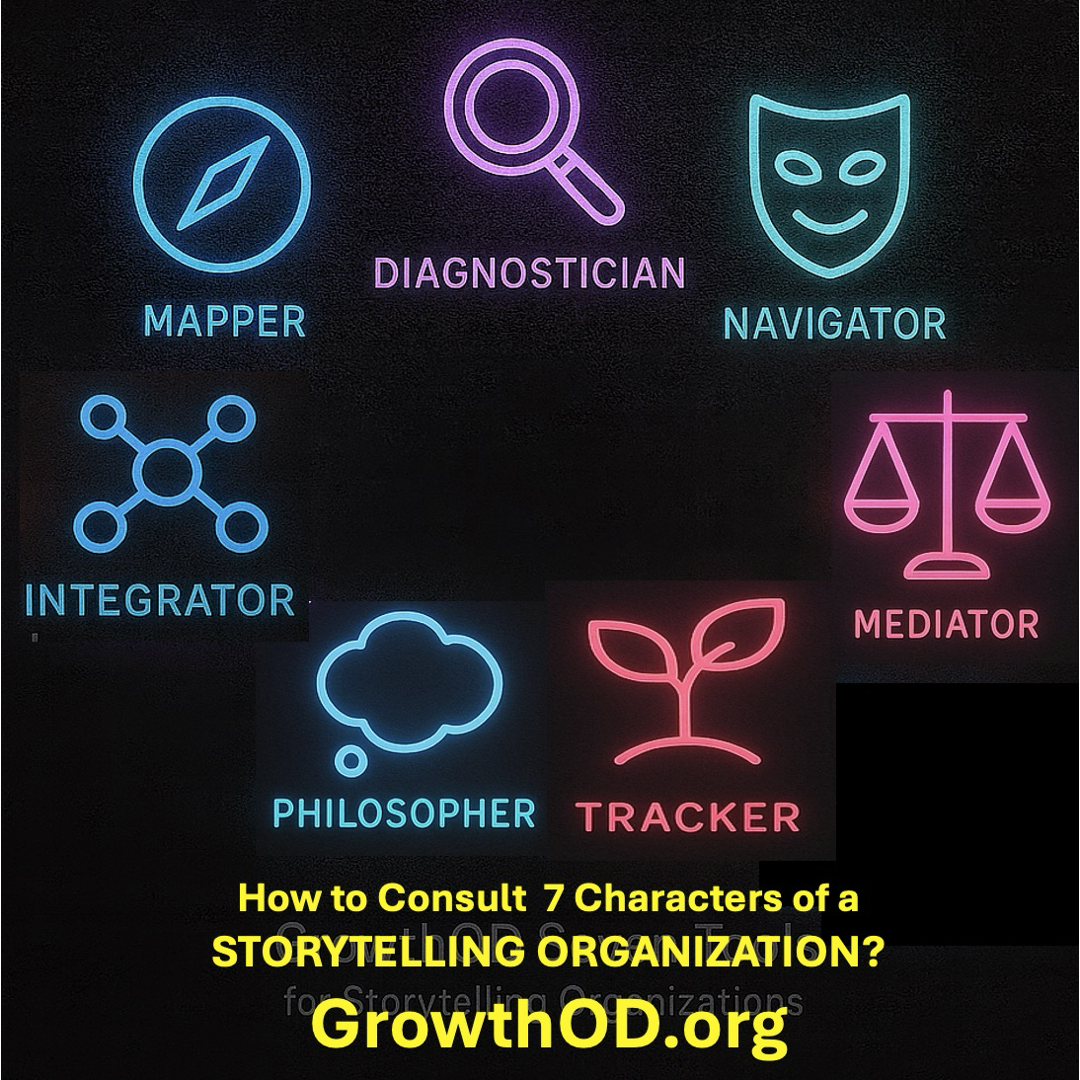
GrowthOD_7_tools_to_consult_coach_Storytelling_Organizations.png

Which Characters are You Coaching & Consulting in Your Storytelling Organization?

From Old Organizational Development to New OD 2.0

Organizations struggle with echo chambers and monologic corporate stories

We shift the central question from "How do I get buy-in for my story?" to "How do we host the stories already living in this system called STORYTELLING ORGANIZATION?"

The Problem

Leadership narratives silence diverse voices of characters  and create compliance rather than commitment. Hidden costs drain resources without clear diagnosis of the STORYTELLING ORGANIZATION

Our Solution

We combine True Storytelling principles (the ethical "why") with GrowthOD operational pillars (the systemic "how")  coaching and consulting, authentic change in Storytelling Organizations.

Understanding This Toolkit: A Polyphonic Approach

These seven tools are not a linear checklist. They are polyphonic voices in dialogue with each other, each speaking from its own embodied stance, each offering a distinct way of seeing and engaging with organizational storytelling. Following Mikhail Bakhtin's concept of polyphony, these tools don't merge into one unified method—they remain in productive tension, questioning and enriching each other.

When you work with storytelling organizations (and every organization is a storytelling organization), you need multiple voices because organizational reality itself is polyphonic. There is no single, authoritative narrative that captures "what's really happening." Instead, there are many voices, many rooms in the Tamaraland, many pre-stories morphing and competing. These tools help you work with that polyphony rather than trying to silence it into false coherence.

How to use this toolkit: Don't start with Tool 1 and proceed linearly to Tool 7. Instead, listen to your client's situation and ask which voices need to speak. Sometimes the Tracker's voice (Tool 5) needs to speak first, catching antenarratives before they harden. Other times the Mediator's voice (Tool 4) must address conflict before any other work can proceed. The tools dialogue with each other—and with you, the practitioner—in an ongoing conversation about what's needed now.

The Seven Voices in Dialogue

The Mapper Character Tool 1: The Mapper's  Character Voice

Stance: "Let me chart the territory. What stories exist here? Where are they flowing? What patterns emerge when we document the whole landscape?"

The Mapper speaks with systematic patience, creating the audit template that reveals what's actually being told across Tamaraland. This voice asks: "Before we intervene, what's here?"

The Diagnostician
              Character Tool 2: The Diagnostician's Character Voice
Stance: "I see the errors in how this organization handles its many voices. Are they committing monologism? Finalizing people's stories prematurely? Avoiding genuine dialogue?"

The Diagnostician speaks with critical precision, using Bakhtin's framework to name what's going wrong. This voice asks: "What polyphony errors are causing dysfunction?"

The Naviagator
              Character Tool 3: The Navigator's Character Voice
Stance: "You cannot be in all rooms at once. Different stories are happening simultaneously in different spaces. How do we navigate this multi-sited reality?"

The Navigator speaks with spatial awareness, mapping Tamaraland's many rooms and the divergent narratives within them. This voice asks: "How do we move through complexity without pretending it's simple?"

Mediator Character Tool 4: The Mediator's Character Voice

Stance: "Conflict is a storytelling process with five stages. Instead of suppressing it or avoiding it, let's work through it stage by stage, restorying as we go."

The Mediator speaks with staged patience, using Pondy's framework to guide leaders through conflict's natural evolution. This voice asks: "How do we transform conflict into organizational learning?"

Tracker Character Tool 5: The Tracker's Character Voice

Stance: "Stories haven't formed yet. I'm tracking the pre-stories, the antenarratives, the seeds before they grow. Catch them now, before they calcify into fixed narratives."

The Tracker speaks with prospective attention, using the 7 B's to monitor fragmentary pre-stories morphing across Tamaraland. This voice asks: "What's emerging before it becomes locked in?"

Philosopher
              Character Tool 6: The Philosopher's Character Voice
Stance: "Every thought carries ethical weight in its once-occurrent event-ness. Are we thinking-and-acting together, or just performing thought without embodied responsibility?"

The Philosopher speaks with ethical urgency, connecting Pondy's enthinkment to Bakhtin's participative thinking. This voice asks: "How do we think together in ways that matter?"

Integrator Character Tool 7: The Integrator's Character Voice

Stance: "All the voices must come together. SEAM methodology weaves socio-economic analysis with antenarrative tracking. No tool works in isolation—everything connects."

The Integrator speaks with synthetic vision, showing how mapping, diagnosis, navigation, mediation, tracking, and philosophy form one comprehensive practice. This voice asks: "How does it all fit together?"

The Polyphonic Practice of 7 Characters As you Consult and Coach the STORYTELLING ORGANIZATION

.                                                       How to Consult and Coach these Characters of a
              StoRYtelLING ORGANIZATION
These seven voices argue with each other. The Mapper wants comprehensive documentation; the Tracker says "but stories are morphing right now—we can't finalize them." The Diagnostician identifies errors; the Mediator says "but conflict is productive—don't pathologize it." The Navigator embraces Tamaraland's multiplicity; the Integrator seeks connections across fragmentation.

This tension is generative, not problematic. In Bakhtinian terms, these tools exist in dialogic relationship—they don't cancel each other out or merge into bland consensus. They remain distinct voices that challenge, complement, and enrich each other. Your job as practitioner is to orchestrate this polyphony, knowing when each voice needs to speak and how they can speak together without drowning each other out.

Start anywhere. Return often. Let the voices speak. The tools will teach you which voice your client needs to hear next.


🗺️ Tool 1: Storytelling Audit Template for Tamaraland

The Mapper's Voice: "Before we intervene, let me chart the territory." Every organization with more than two rooms is a Tamaraland where you cannot be in all spaces at once. Different stories unfold simultaneously in different rooms—executive suites tell growth narratives while operations floors tell survival stories, marketing performs customer-love tales while support teams share burnout warnings. This tool maps the fragmented, competing storylines across your client's organizational landscape. You're not searching for one true story (it doesn't exist). You're documenting the polyphonic reality—the precedent stories people tell about the past, the future-directed bets they're making, the living stories unfolding right now, and the counter-stories marginalized voices keep trying to tell. Think of yourself as the systematic documentarian who reveals: "Here's what's actually being performed in each room of this Tamaraland."

Tool 1: Storytelling Audit Template for Tamaraland

Opening: Chasing Stories from Room to Room

Picture this: You're consulting for a mid-sized company. The CEO tells you one story about why the reorganization failed. When you talk to middle managers, you hear a completely different story. The frontline employees? They're telling yet another version. And the story customers are posting online bears almost no resemblance to any of these internal narratives.

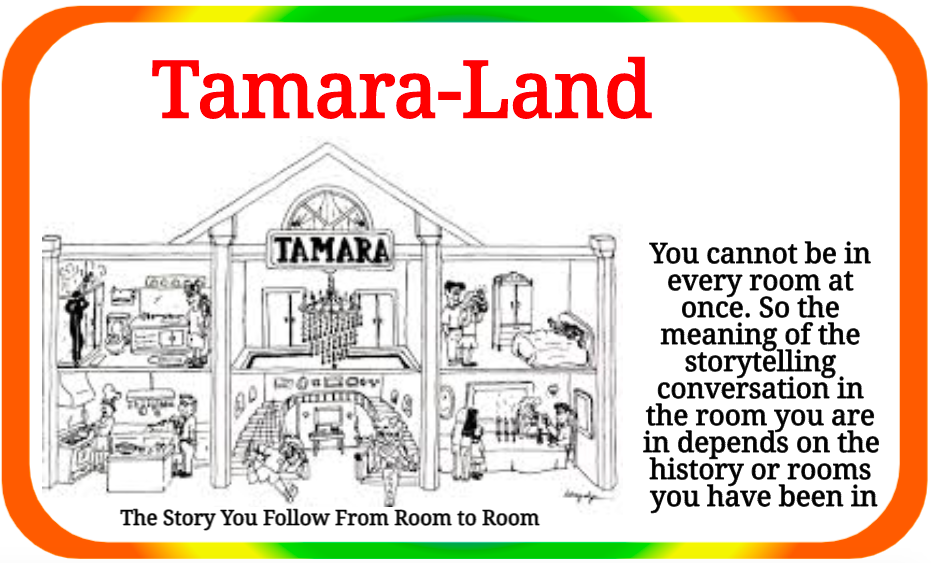
Welcome to Tamaraland—every organization with more than two rooms. The metaphor comes from a theatrical production called Tamara, where audience members chase actors through multiple rooms in a mansion, catching fragments of simultaneous storylines but never experiencing the whole play from one vantage point. You cannot be in more than one room at a time. Meanwhile, different stories are unfolding in different spaces, and they're often contradictory, competing, and collectively constituting organizational reality.

This isn't a problem to solve—it's the nature of organizational life. As I documented in my 1991 study of an office supply firm and my 1995 analysis of Disney, organizations are storytelling systems. Stories aren't just communication tools; they constitute the performance system that shapes identity, power, change, and sensemaking. The Storytelling Audit Template helps you map this multi-sited, polyphonic reality so you can work with it rather than against it.

Core Concepts: Understanding the Storytelling Organization

What is a Storytelling Organization?

Every organization is a storytelling organization. In my first field study in 1991, I spent months observing how employees in an office supply firm performed stories in everyday conversations—brief, fragmented, often challenged by listeners, yet constituting collective memory and shared sensemaking. These weren't polished corporate narratives with clear beginnings, middles, and ends. They were terse story performances where speakers assumed listeners would silently fill in major portions of the storyline.

Three characteristics define storytelling organizations:

1. Story Performance, Not Just Story Text

Stories in organizations aren't static texts—they're performances that vary by context, audience, and political purpose. The same "official story" about a new initiative gets performed differently in the executive suite, in department meetings, at the water cooler, and in exit interviews. When you audit organizational stories, you're tracking performances and how they shift across contexts, not just collecting written narratives.

2. Collective Storytelling Systems

Individual organizational members don't possess complete stories. Instead, they contribute fragments to a collective storytelling system where institutional memory supplements individual memories. People perform story bits that others pick up, challenge, revise, and re-perform. The organization's "story" emerges from this distributed, dynamic system, not from any single authoritative telling.

3. Tamara-land Structure

Organizational storytelling unfolds in multiple rooms simultaneously, with different audiences chasing different storylines. When I studied Disney in the mid-1990s, I found the organization operated as literal and metaphorical Tamara-land: tourists chased stories through themed lands, employees experienced divergent narratives in front-stage and back-stage spaces, and marginalized voices told darker counter-stories the official Disney legend excluded. Your client's organization works the same way—multiple stories happening at once in different spaces, and you can't catch them all from one position.

The Four Types of Stories You'll Find

When conducting a storytelling audit, you're tracking four kinds of stories that interplay in organizational Tamaraland:

1. Precedent Stories (Past-Oriented)

These are "how we got here" stories that organizational members tell to make sense of current situations by referencing past events. They include founding myths, war stories, cautionary tales, and historical precedents people invoke to justify present actions. In my 1991 consulting study, I found people performed precedent stories to support or resist change initiatives—"Remember what happened last time we tried this?"

2. Future-Directed Stories (Speculative)

These are the bets, plans, visions, and "what if" scenarios people tell about possible futures. Leaders tell aspirational stories to inspire; employees tell skeptical stories to inoculate against disappointment; consultants tell change stories to mobilize action. Future-directed stories are often antenarratives—fragmented pre-stories that haven't yet crystallized into coherent narratives.

3. Living Stories (Present-Moment)

These are the unfolding, in-process stories happening right now in organizational life. They're embodied, situated, and often unfinished. When you observe a contentious meeting, witness a customer interaction, or watch a team struggle through a problem, you're seeing living story—the raw material before it gets retrospectively narrated into tidier versions.

4. Counter-Stories (Marginalized Voices)

These are the stories official narratives exclude or suppress. They come from marginalized employees, dissatisfied customers, critics, whistleblowers, or anyone whose experience contradicts the dominant story. When I analyzed Disney, I found rich counter-stories about labor exploitation, environmental destruction, and cultural imperialism beneath the surface of the happy Magic Kingdom narrative. Every organization has counter-stories—the storytelling audit makes them visible.

Why "Audit" Is the Wrong Word (But We Use It Anyway)

Traditional audits assume you're counting objective things that stay still while you count them. Organizational stories don't work that way. They're dynamic, contextual, and performative. They change based on who's listening, shift mid-telling, get challenged and revised, and morph across spaces. So when we say "storytelling audit," we don't mean a static inventory. We mean a systematic process of tracking story performances across your client's Tamaraland to reveal patterns, contradictions, silences, and possibilities.

The Political Nature of Organizational Storytelling

Stories in organizations are never neutral. They're tools of power, resistance, sensemaking, and change. In my 1991 field observations, I watched employees perform stories to gain political advantage, introduce change, make sense of confusing events, and challenge authority. Managers told stories that reinforced hierarchy; workers told stories that subverted it. Some stories were told openly in meetings; others were whispered in hallways. Some storytellers had authority that made their versions stick; others' versions got dismissed as "just complaining." The audit reveals not just what stories exist, but who has the power to make their stories become organizational truth.

How to Apply It: Conducting the Storytelling Audit

Step 1: Map the Tamaraland

Start by identifying the physical and metaphorical rooms in your client's organization. Physical rooms might be departments, locations, hierarchical levels, customer touchpoints, or supplier interfaces. Metaphorical rooms might be formal meetings versus hallway conversations, official communications versus back-channel gossip, or digital spaces versus embodied interactions. Create a simple map showing these rooms and note: you cannot be in all rooms simultaneously, and different stories are happening in each.

Step 2: Position Story Collectors in Multiple Rooms

You need multiple observers to track simultaneous story performances. If you're a solo consultant, you'll need to move through rooms systematically over time. If you're a team, position people in different rooms. The goal is gathering story fragments from across the Tamaraland, not achieving complete coverage (which is impossible). Instruct collectors to listen for:

Step 3: Track the Four Story Types

For each room in your Tamaraland map, collect examples of precedent stories, future-directed stories, living stories, and counter-stories. Use a simple matrix:

Room/Space Precedent Stories Future-Directed Living Stories Counter-Stories
Executive Suite [Examples] [Examples] [Examples] [Examples]
Middle Management [Examples] [Examples] [Examples] [Examples]
Frontline Staff [Examples] [Examples] [Examples] [Examples]

Don't try to capture complete stories. Capture the fragments, the terse performances, the story openings that never get finished. That's the real data.

Step 4: Identify Story Patterns and Contradictions

Once you've collected fragments across the Tamaraland, analyze for patterns:

Step 5: Map Political Story Work

Stories in organizations are inherently political. People perform stories to gain advantage, resist authority, justify decisions, and shape collective memory. Track:

Step 6: Present Audit Findings as Tamaraland Map

Don't present your findings as "the organizational story"—that would deny the polyphonic reality you've discovered. Instead, present the Tamaraland map showing simultaneous, competing storylines. Use visuals showing:

Your job isn't to resolve contradictions into false coherence. Your job is making the polyphonic reality visible so the organization can work with it.

Step 7: Design Story Interventions

Once the audit reveals the storytelling landscape, you can design interventions:

Example: Healthcare System Merger

A regional healthcare system hired me after a merger created massive dysfunction. The storytelling audit revealed why: Hospital A told a precedent story about being the "flagship" with superior clinical care. Hospital B told a counter-story about being the "community hospital" that actually cared about patients versus profits. In executive meetings (one room), leaders performed a future-directed story about "unified excellence." On nursing floors (other rooms), staff performed living stories about resource wars and quality decline. Patient forums (yet another room) surfaced counter-stories about worse outcomes post-merger.

The audit made visible that this wasn't one merger story—it was competing storylines in different Tamaraland rooms with no bridges between them. The intervention involved creating cross-room story sessions where Hospital A and Hospital B staff performed their precedent stories to each other, then co-created new future-directed stories that honored both legacies. Nursing staff finally got to tell their living stories of struggle to executives. Patient counter-stories were integrated into quality improvement initiatives instead of dismissed as "complaints."

Six months later, storytelling patterns had shifted. The organization hadn't achieved false unity—it still had multiple stories in different rooms. But the stories were in dialogue rather than opposition, and marginalized voices had more authority in collective sensemaking.

Key Takeaways

🔍 Tool 2: Consulting in Storytelling Organizations

The Diagnostic Voice: "I see the errors in how this organization handles its many voices." Every storytelling organization makes predictable mistakes when dealing with polyphony—the multiple, competing voices that constitute organizational reality. This tool applies Mikhail Bakhtin's framework to diagnose six critical errors: monologism (forcing all voices into one official story), finalization (prematurely closing people's stories as "finished"), theoretism (abstracting people into categories instead of seeing their unique voices), secondhand discourse (repeating hollow corporate-speak), carnival suppression (eliminating playful challenge to authority), and dialogue avoidance (preventing genuine multi-voiced conversation). You're the critical diagnostician who names what's going wrong: "Your organization is committing monologism, and it's costing you innovation, engagement, and authentic change." This is precision consulting that identifies the specific polyphony failures causing dysfunction.

Mikhail Bakhtin's Polyphony and Errors Consultants fall into Transforming 'Storytelling Organizations'

Mikhial identifies the serious errors in Polyphony that earlier author-thinkers made concerning Dostoeveky's approach to Polyphony. Each error helps us understand how to consult the Storytelling Organization. They constitute a Toolkit for consultants and coaches.

🧠 Summary Table: Polyphony Errors in Tamaraland

Error Type Impact on Tamaraland Boje’s Remediation
Monologic Hierarchy Managerial dominance, silenced voices Antenarrative disruption, story audits
Deterministic Mechanism Mechanized storytelling, predictable change Quantum storytelling, antenarrative tracking
Ideological Simplification Stories reduced to binary categories True storytelling ethics, contradiction prompts
Neglect of Unfinalizability Premature closure of stories Enthinkment, reflective journaling
Authorial Puppetization Stakeholders used to validate leadership scripts Agential antenarratives, role-play restorying

📌 Breakdown of Consultant Errors in Polyphony Transformation of Storytelling Organizaitons

Each row represents a Bakhtinian error, showing:

Scholar Error Type Impact on Consulting Toolbox Remediation Strategy
Komarovich Monologic hierarchy Reinforces dominant managerial narratives Disrupt hierarchy with bottom-up prompts
Englehardt Deterministic mechanism Mechanizes storytelling, seeks resolution too quickly Embrace emergent, open-ended storytelling
Askoldov/Grossman Ideological simplification Categorizes stories, loses nuance Invite complexity and contradiction
Kaus Neglect of unfinalizability Pushes for closure, treats stories as static Encourage iterative, evolving storytelling
Vyacheslav Authorial puppetization Uses stories to validate pre-set agendas Facilitate co-creation and reframing


Next, See YouTube of Formal Axiology Critique and Value Capture and Dostoevsky Polyphony

Consulting in Storytelling Organizations Toolkit is affected by several Bakhtinian polyphony errors as identified in critiques of scholars like Vyacheslav Komarovich, Askoldov, Grossman, Kaus, and Englehardt. Here's a breakdown of how each error manifests and how it can distort the effectiveness of the consulting toolbox:

Five Errors Consultants comit when transforming
            Storyteling Organizations to Polyphony

David Boje and colleagues define Storytelling Organizations as dynamic entities where narrative and storytelling are central to how organizations make sense of themselves and their environment. In his book Storytelling Organizations (2008), Boje emphasizes that:

🧭 Core Definition

A Storytelling Organization is one in which storytelling is not just a communication tool but a fundamental process through which strategy, development, learning, and identity are shaped. [Storytelli...ations Inc]


Mind Map of Formal Axiology Critique and Value
              Capture and Dostoevsky Polyphony

Mind Map of Formal Axiology Critique and Value Capture and Dostoevsky Polyphony


Click  Here for Expanded Mind Map


🔍 Key Characteristics of Storytelling Organizations

  1. Narrative as Strategy
    Stories are used to frame organizational goals, justify decisions, and align members around shared visions.

  2. Multiplicity of Voices
    Organizations contain official stories, shadow stories, and antenarratives—each offering different perspectives and tensions.

  3. Temporal Complexity
    Storytelling spans past, present, and future—Boje introduces antenarratives as pre-narrative fragments that forecast possible futures.

  4. Living Stories
    Stories are not static; they evolve through interaction, conflict, and reinterpretation. This aligns with Bakhtin’s concept of unfinalizability.

  5. Restorying and Change
    Storytelling is a method for organizational change, allowing members to restory dominant narratives and surface marginalized voices.

  6. Ethical and Dialogic Engagement
    Storytelling organizations are ethically committed to dialogue, resisting monologic control and deterministic systems.

🔑 Core Features of Dostoevsky’s Polyphony

  1. Plurality of Independent Voices
    Each character in Dostoevsky’s novels is treated as a fully autonomous consciousness. These voices are not subordinated to the author’s ideology or narrative control—they exist in genuine dialogue with one another.

  2. Unmerged Consciousnesses
    Unlike traditional novels where characters serve the author’s vision, Dostoevsky’s characters are not objectified or reduced to ideological types. They are subjects, capable of engaging in philosophical and ethical debate.

  3. Dialogic Interaction
    The novel becomes a carnival of ideas, where no single voice dominates. The author does not impose a final word but allows open-ended, unfinalizable dialogue among characters.

  4. Author as a Creator of Dialogue, Not a Dictator of Meaning
    Dostoevsky’s authorial role is unique: he does not resolve the ideological conflicts but creates the conditions for their coexistence. Bakhtin calls this the “polyphonic author”—one who orchestrates dialogue without collapsing it into monologue.

  5. Ethical Commitment to Human Plurality
    Polyphony is not just a stylistic device—it reflects a deep ethical stance. It honors the irreducible otherness of each voice and resists totalizing systems of thought.


🔴 1. Komarovich’s Monologic Will (Hierarchy Error)

Error Description:
Komarovich reduces polyphony to a hierarchical structure where voices are subordinated to a dominant authorial or managerial will.

Impact on Consulting Toolbox:

Remediation Strategy:


🔴 2. Englehardt’s Deterministic Mechanism (Systemic Constraint Error)

Error Description:
Englehardt imposes deterministic or mechanistic systems that strip away dialogic freedom, treating human agency as predictable or organicized.

Impact on Consulting Toolbox:

Remediation Strategy:


🔴 3. Askoldov and Grossman’s Ideological Simplification

Error Description:
These scholars reduce characters’ voices to ideological positions, stripping away their complexity and autonomy.

Impact on Consulting Toolbox:

Remediation Strategy:


🔴 4. Kaus’s Neglect of Unfinalizability

Error Description:
Kaus fails to recognize the open-ended, evolving nature of polyphonic dialogue.

Impact on Consulting Toolbox:

Remediation Strategy:


🔴 5. Vyacheslav’s Authorial Puppetization

Error Description:
Characters (or organizational voices) are treated as puppets of a central authorial intent.

Impact on Consulting Toolbox:

Remediation Strategy:


 Summary Table: Polyphony Errors Affecting the Consulting Toolbox

Scholar Error Type Impact on Consulting Toolbox Remediation Strategy
Komarovich Monologic hierarchy Reinforces dominant managerial narratives Disrupt hierarchy with bottom-up prompts
Englehardt Deterministic mechanism Mechanizes storytelling, seeks resolution too quickly Embrace emergent, open-ended storytelling
Askoldov/Grossman Ideological simplification Categorizes stories, loses nuance Invite complexity and contradiction
Kaus Neglect of unfinalizability Pushes for closure, treats stories as static Encourage iterative, evolving storytelling
Vyacheslav Authorial puppetization Uses stories to validate pre-set agendas Facilitate co-creation and reframing


🎭 Tool 3: Tamaraland Mapping for Multi-Voiced Organizations

The Navigator's Voice: "You cannot be in all rooms at once—different stories are happening simultaneously in different spaces." Organizations aren't single-room theaters with one coherent narrative. They're Tamaralands where multiple storylines unfold in parallel across departments, locations, hierarchies, and stakeholder groups. While the C-suite performs growth narratives in the boardroom, operations tells survival stories on the floor, marketing spins customer-love tales in campaigns, and former employees share exit narratives online. This tool helps you navigate multi-sited organizational reality without pretending it's simpler than it is. You're mapping the divergent, contradictory, competing stories across your client's landscape and creating pathways for these fragmented voices to connect. The Navigator asks: "How do we move through this complexity with integrity, acknowledging we'll never see the whole picture from one vantage point?"

Tamara-Land, introduced by Boje (1995), models the organization as a multi-roomed, multi-voiced stage, much like the physical structure of the play Tamara. In this environment, reality is plurivocal. Each participant’s experience of the organizational story is “true” but unique to themselves. Organizational life is understood as "a multiplicity, a plurality of stories and story interpretations in struggle with one another".

We propose ensemble leadership is a collective, relational, and heterarchical approach to leadership that draws from indigenous contexts and emphasizes collaboration over hierarchical authority(Rosile et al., 2019).

Tamara-Land Boje 1995 AMJ article


TamaraLand

"Tamara-land" (Boje, 1995) illustrates how multi-room, multi-character storytelling can distort shared meaning unless intentionally facilitated. In Boje’s (1995: 999) ‘Disney as Tamara-land,” people arriving to a meeting from different rooms in an organization will amplify the distortions: “Two people can even be in the same room and—if they came there by way of different rooms and character-sequences—each can walk away from the same conversation with entirely different stories.”  Most organizations have more than 12 rooms. “If there are a dozen stages and a dozen storytellers, the number of story lines an audience could trace as it chases the wandering discourses of Tamara is 12 factorial (479,001,600)” (Boje, 1995.)

“Still, instead of repairing mechanistic or organic metaphors, I believe it is time to heed Pondy and Mitroff's advice and move to discursive metaphors, such as Lyotard's (1984) ’conversation,’  Bakhtin's (1981) ’novel,’ and Thatchenkery's (1992) ‘text.’ Tamara is a discursive metaphor highlighting the plurivocal interpretation of organizational stories in a distributed and historically contextualized meaning network—that is, the meaning of events depends upon the locality, the prior sequence of stories, and the transformation of characters in the wandering discourses.” Boje, 1995: 1000).

Therefore, to address the contradictory intersubjectivity in the discursive arean, the SEAM method encourages the gathering of various types of data (interviews, observations, documents, and reports) and engagement in co-inquiry.  Why It Matters: (1) Decision-Making: Wise decisions arise not from isolated minds, but from the resonance of many voices in intersubjective space. (2) Change and Transformation: Lasting change happens when new intersubjective realities are co-created—when people see, feel, and act from a new shared story. (3) Ensemble Leadership: Leadership is intersubjective—an improvisational dance of sensing, responding, and co-creating in the moment. Contradictory Intersubjectivity in organizations is the living, breathing quantum energetic field of shared meaning and presence that makes collective wisdom, creativity, and transformation possible. It is the foundation for ensemble leadership and the quantum leap from isolated action to collective becoming.

Ensemble leadership involves multiple voices and perspectives working together harmoniously, much like an ensemble in music or theater. Ensemble Leadership can accomplish strategic change into polyphony.

The concept of polyphony, inspired by Mikhail Bakhtin’s work in Problems of Dostoevsky’s Poetics (1984), refers to the coexistence of multiple independent voices or viewpoints, each with equal validity, creating a rich, dialogic narrative. In ensemble leadership, this is accomplished through heterarchy—a non-hierarchical structure where power and decision-making are distributed across individuals or groups rather than concentrated at the top. This allows diverse perspectives to interact dynamically, fostering creativity, inclusivity, and adaptability, as outlined in Rosile, Boje, and Claw’s 2018 article on ensemble leadership theory
This complexity is driven by antenarratives, defined as the state of storytelling "before fixed coherence is imposed, existing as a 'fragmented, non-linear, incoherent, collective, unplotted and pre-narrative speculation, a bet'" (Boje, 2001, as cited in). The purpose of the Tamara-Land Map Exercise is to systematically map these simultaneous storylines, diagnose the failures in communication (known as polyphony errors), and design robust interventions to promote dialogic health.

In sum, ensemble leadership is a collectivist, relational, dynamic, and heterarchical theory rooted in indigenous worldviews and poststructural approaches to leadership. It accomplishes polyphony—multiple voices and perspectives in collective leadership—through fluid, non-hierarchical social organizations called heterarchies, wherein leadership is co-created and distributed across all members, rather than centralized in any individual or static group.

What Is Ensemble Leadership?

Ensemble leadership theory (ELT) describes leadership as a collective, relational process rather than an individual function or static entity. In an ensemble, like a group of actors with no single star, all may contribute leadership in different ways and moments, avoiding the hero-leader model prevalent in Western traditions. ELT moves beyond the dualisms of leader/follower and individual/group, viewing them as false oppositions, and sees leadership as a dynamic process enacted by the collective—every member can become a leader, and roles continually shift.

Heterarchy and Polyphony

Heterarchy is central to ELT, signifying multiple, interacting hierarchies or a decentered organization structure. Rather than fixed positions or rankings, the group (ensemble) can fluidly morph into different configurations—from hierarchical to egalitarian—according to changing needs and contexts, with no rigid order predetermined over time. This constant movement fosters a rich polyphony, echoing Mikhail Bakhtin’s concept in literary theory: many voices, stories, and perspectives co-exist, interact, and transform meaning within the collective. ELT deploys “rhizomatic” structures (borrowed from biology and poststructural theory) in which any node can become a temporary center, amplifying diverse voices and storytelling forms.

Collective Storytelling and Antenarrative

In ensemble leadership, storytelling is cyclical, spiral, and especially rhizomatic—open-ended, polyphonic, and ambiguous, diverging from the linear, cause-effect narratives dominant in Euro-Western organizational contexts. "Antenarrative"—the before-story, or the chaotic and fragmented context from which organized storytelling emerges—is key to ELT: it provides space for multiple voices, shifting perspectives, and material conditions (including nonhuman agency) to actively shape leadership processes. The entire collective engages in sensemaking and leadership enactment, where every member’s story contributes to the shared direction.

Why Polyphony Matters

Polyphony, as Bakhtin describes, is the interaction of independent and equally valid voices and consciousnesses, rather than a single authoritative view. ELT realizes polyphony through heterarchy: any member, any group, or even nonhuman elements (such as place, environment, or artifacts) can take the lead, shaping the group’s story and process. This approach is inherently egalitarian and open, allowing for a richer, more flexible and responsive form of leadership suitable for complex, changing environments.

Table: Ensemble vs. Other Leadership Models

Approach

Leadership Nature

Locus

Hierarchy/Structure

Storytelling Style

Dispersed

Entity/Category

Individual

Self-leadership, static

Fractal, repeating

Distributed

Entity/Category

Multiple

Hierarchy, top down

Linear, BME

Relational

Interpersonally negotiated

Multiple

Negotiated, interpersonal

Cyclical/spiral

Ensemble

Collectively co-created

Community

Heterarchy, dynamic

**Rhizomatic, polyphonic

All ensemble processes are fundamentally based on collective negotiation, dynamic role shifts, and multi-channel communication, providing a time-tested model for polyphonic, egalitarian leadership.

This framework blends indigenous insights, poststructuralist thought, and storytelling theory to accomplish polyphony: the simultaneous, dialogical presence of many voices—in leadership, storytelling, and organizational practice.


⚖️ Tool 4: Restorying Leadership Conflict

The Mediator's Voice: "Conflict is a storytelling process with five predictable stages—let's work through it together, not around it." When leadership teams collide, they're not just disagreeing about strategy or resources—they're caught in conflict as a narrative event unfolding through Louis Pondy's five stages: latent conflict (conditions ripe for clash), perceived conflict (sensing tension), felt conflict (emotional activation), manifest conflict (open warfare), and conflict aftermath (what remains after the battle). Most consultants try to suppress or avoid conflict. This tool helps you facilitate restorying—guiding leaders through conflict's natural progression so they transform rather than repeat it. You're the patient mediator who says: "We're in Stage 3—let's acknowledge the emotions before we jump to solutions, or this will just cycle back." Conflict becomes organizational learning when you work with its stages, not against them.

Format: Worksheet + coaching prompts
Purpose: Address leadership storytelling battles (boardroom conflicts, CEO-vs-investor narratives)

Components:

.

Leadership Conflict is analyzed in Louis Pondy’s model

Pondy’s model of organizational conflict provides a valuable framework for understanding and addressing leadership conflicts in organizations. The model is structured around five distinct stages, each highlighting a different dimension of how conflicts emerge, develop, and resolve within groups, including leadership teams. In his seminal 1967 article, Pondy also identifies three types of organizational systems where conflict dynamics play out.


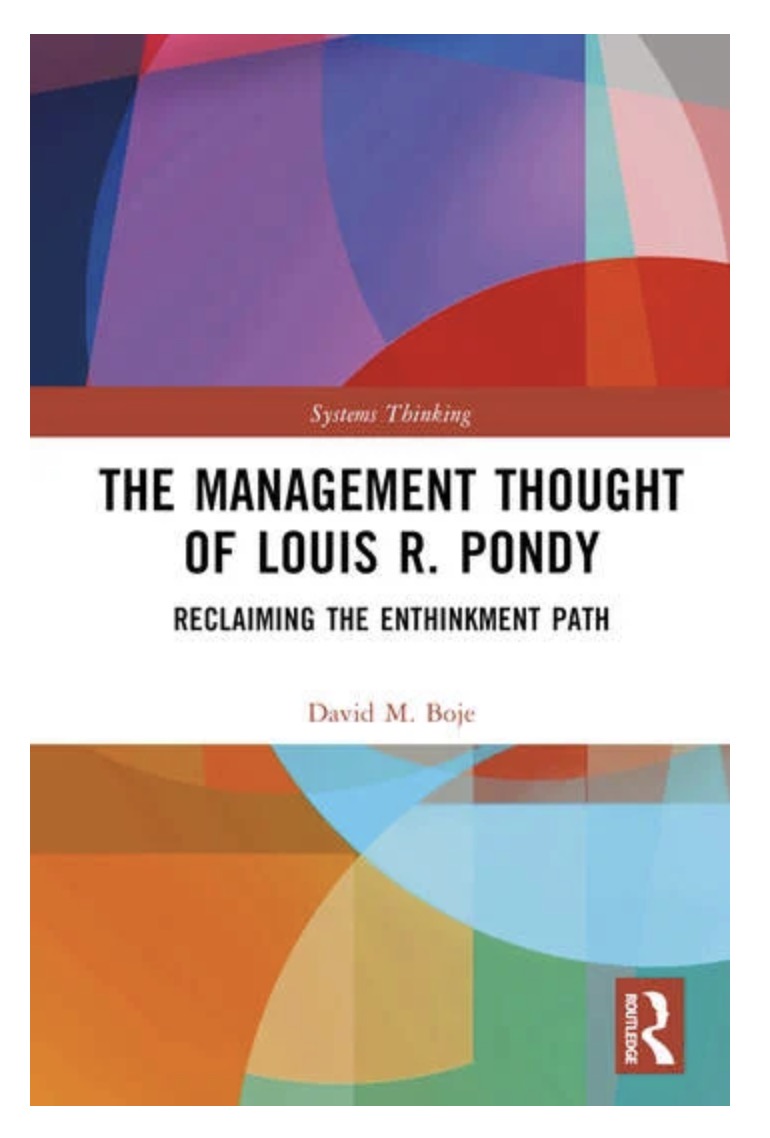
Figure 1: The Conflict Model is from Boje, D. M., & Saylors, R. (2023). The management thought of Louis R. Pondy: Reclaiming the enthinkment path. Routledge. This diagram has the loop arrow from conflict aftermath or resolution back to the Aftermath of Preceding Conflict Episodes, which was missing from Pondy’s (1967) article, but was in his original dissertation model.

PERVIEW coaching offers a robust narrative and energy-based method for transforming leadership conflict, integrating embodied practices and storytelling into each stage of the Pondy conflict model. Applying all seven PERVIEW steps to Pondy's (1967) framework illuminates how narrative coaching can strategically guide leaders through complex organizational disputes.

Integrating PERVIEW Coaching with the Pondy Conflict Model

Pondy's conflict model organizes conflict into five stages: latent, perceived, felt, manifest, and aftermath, with each stage requiring unique interventions and perspectives for lasting resolution (Pondy, 1967). The seven steps of the PERVIEW method—Processes, Embodied, Restorying, Vibrations, Internal, Energy, Waves—expand upon each stage by facilitating narrative transformation, energetic rebalancing, and restorying for positive leadership outcomes (Boje & Rosile, 2025).

Step 1: Characterize Dysfunction and Possibility (Latent Conflict)

In the latent stage of Pondy's model, underlying conditions create the potential for conflict, even if not yet recognized (Pondy, 1967). PERVIEW coaching invites leaders to surface unspoken stories, identify contradictions, and assess vibrational energy patterns associated with resource scarcity, autonomy challenges, and divergent goals. Coach prompts such as "What unspoken stories are present about work conditions?" activate awareness and lay the foundation for narrative transformation (Boje & Rosile, 2025).

Step 2: Externalize Problems (Perceived Conflict)

As leaders become aware of looming conflict, PERVIEW coaching encourages externalization—moving the problem-laden narrative outside the person into systems and patterns. By naming character archetypes or "systemic forces," leaders see that dysfunction emerges from complex organizational systems, not individual flaws. This reframing clarifies areas such as training gaps or policy mismanagement, aligning with Pondy's emphasis on perceived threats to the status quo (Boje & Rosile, 2025; Pondy, 1967).

Step 3: Sympathize—Emotional Truth and Payoff (Felt Conflict)

Felt conflict is marked by emotional intensity, tension, and personalization of conflict (Pondy, 1967). In PERVIEW, the coach facilitates empathic dialogue to surface emotional realities—for example, how repeated communication fatigue or ignored contributions have shaped morale. This step is essential for restoring safety, validating embodied responses, and guiding leaders toward honest self-inquiry (Flora et al., 2016; Boje & Rosile, 2025).

Step 4: Revise—Testing New Narratives (Manifest Conflict)

During manifest conflict, open behaviors—verbal disagreements, opposition—surface. The PERVIEW coach helps leaders co-create revised narratives, envision more humane practices, and experiment with new behaviors and rituals. By testing change (e.g., new meeting protocols), leaders move past stuck storylines and actualize preferred futures, directly addressing behaviors and structures visible in manifest conflict (Boje & Rosile, 2018; Cast et al., 2013).

Step 5: Strategize—Planning Change and Exceptions

Post-revision, coaching shifts to action planning by highlighting "little wow moments"—exceptions that reflect desired practices. Leaders strategically implement new protocols and rhythms (e.g., daily huddles for coordination), reinforcing effective change and embedding narrative adjustments into organizational routines (Boje & Rosile, 2025).

Step 6: Rehistorize—Embedding Stories in Time (Aftermath)

In the aftermath stage, Pondy emphasizes lingering effects and learning after conflict resolution (Pondy, 1967). PERVIEW's rehistorizing step guides leaders to weave new stories into broader organizational timelines—connecting past, present, and future to transform legacy beliefs. This step ensures that healing is sustainable, and that updated narratives inform ongoing practices (Rosile & Boje, 2002; Rosile et al., 1998).

Step 7: Publicize and Anchor—Shared Identity

Finally, leaders share the new story with stakeholders, solidifying identity changes through communication rituals—voice, posture, symbols. The closing ceremony involving breathwork and somatic anchoring marks the transition from old to new meanings, ratifying transformation (Boje & Rosile, 2025).

Analysis of the Disney/Kimmel Leadership Conflict Using the PERVIEW Method and Pondy’s Conflict ModelSession Start

Step 1: Characterize Current Dysfunctions and the Organization at Its Best (Latent Conflict)

Step 2: Externalize Move the 'Problem Saturated Account' (Perceived Conflict)

Step 3: Sympathize With the Payoff for Keeping Habits (Felt Conflict)

Step 4: Revise What Are the Consequences? Test Revised Narratives (Manifest Conflict)

Step 5: Strategize List ‘Little Wow Moments’ and Turn Into Plans

Step 6: Rehistoricize Embed the New Story Into a Timeline (Aftermath)

Step 7: Publicize Who Can You Tell? Share the New Story

@FreeKimmel

, 2025) amplifies this (Boje, 2025).

Closing Ceremony

·       Ritual: Box breathing (4-4-4-4), state the new leadership story aloud, clap three times, ratify with “That was a big one, wasn’t it?” (Boje & Rosile, 2025).


🌱 Tool 5: Antenarrative Pre-Story Tracker – The 7 B's Framework

The Tracker's Voice: "Stories haven't formed yet—I'm catching the seeds before they grow." Every polished narrative your client tells started as antenarrative—fragmented hunches, half-formed ideas, competing speculations swirling across the organization. These pre-stories are morphing right now in the restorying process, and you cannot make narratives without them. This tool tracks seven antenarrative processes (the "7 B's") before they calcify into fixed stories: BENEATH (hidden values and assumptions), BEFORE (multiple histories shaping present sensemaking), BETS (speculative wagers on possible futures), BEING (present-moment action and creation), BECOMING (transformation and evolution underway), BETWEEN (relationships across Tamaraland's rooms), and BEYOND (intuitive reflection transcending polarities). You're working upstream—catching organizational pre-stories while they're still plastic, before premature narrative closure locks them into forms that may not serve your client's future.

Tool 5: Antenarrative Pre-Story Tracker – The 7 B's Framework

Opening: The Seeds That Grow Into Stories

Every polished story you tell in your organization started somewhere else—as fragments, hunches, half-formed ideas, and possibilities swirling in the minds of your people. These aren't stories yet. They're what David Boje calls antenarratives—the pre-story seeds that haven't crystallized into narratives with clear beginnings, middles, and ends. Think of them as the raw material of organizational storytelling, the unplotted speculation that precedes every coherent narrative your company eventually tells.

Here's why this matters to you as a consultant or coach: You cannot make a narrative without antenarratives. More importantly, antenarratives are always renewing and morphing in what Boje calls the "restorying process." While traditional consultants focus on the finished stories organizations tell themselves, antenarrative work helps you track and shape the pre-stories before they harden into fixed narratives that may not serve your client well. This is upstream work—catching the story before it calcifies.

The challenge? Your clients live in Tamaraland. Every organization with more than two rooms is a Tamaraland, and you cannot be in more than one room at a time. Different pre-stories are emerging simultaneously in different spaces, and they're often contradictory. The 7 B's framework gives you a systematic way to track these fragmentary antenarratives across your client's organizational landscape.

Core Concepts: Understanding the Seven Antenarrative Processes

Boje developed the concept of antenarrative in his 2001 book Narrative Methods, initially focusing on two dimensions: Before (ante meaning "prior to") and Bets (ante meaning "wager"). Over two decades of research and practice, he identified seven distinct processes that constitute how pre-stories emerge and eventually become narratives. These aren't sequential stages—they're simultaneous, interweaving processes happening throughout your client's organization.

What exactly is an antenarrative? Boje defines it as "the fragmented, non-linear, incoherent, collective, unplotted, and pre-narrative speculation, a bet, a proper narrative can be constituted" (2001: 1). It's the messy, unfinished, multi-vocal storytelling that happens before someone imposes plot, coherence, and closure. It's prospective rather than retrospective—looking forward to possible futures rather than backward at settled pasts.

The seven processes organize into what Boje calls the "Four Hearts" (vertical/spatial) and three temporal processes that connect them:

1. BENEATH – The Heart of Abstraction

This is the foundation layer—the values, assumptions, motivations, and unconscious drivers beneath the surface story. In consulting terms, it's what you're hunting for when you ask "What's really going on here?" BENEATH work means going below the official narrative to uncover the fore-conceptions (preconceived notions) that shape how people interpret events. It's about uncovering hidden forces: the unspoken values, the tacit assumptions, the "that's just how we do things" that nobody questions. When a leadership team tells you "we value innovation" but punishes every failed experiment, you're seeing the gap between stated narrative and BENEATH reality.

Practitioner Question: What assumptions and values are driving behavior beneath the surface story your client tells?

2. BEFORE – The Heart of Historical Context

BEFORE captures the multiple histories and past experiences that shape current sensemaking. This isn't just "company history"—it's the layered, often contradictory stories about what happened before. In Tamaraland terms, different rooms have different BEFORE stories. The sales team's version of "what happened in Q3" differs from engineering's version, which differs from the CEO's version. BEFORE work means acknowledging that your client's organization has multiple pasts, not one tidy history. These various pasts are "already there in advance" (what Boje calls "fore-having"), shaping how people make sense of present situations.

Practitioner Question: What different histories are people carrying forward, and how do these shape their current interpretations?

3. BETS – The Heart of Prospective Sensemaking

BETS represents the wagers people make about possible futures—the "what if" scenarios, the risks they're willing to take, the prospective sensemaking before outcomes are known. Every strategic initiative is a BET, but so is every manager's decision about which project to prioritize, every employee's choice about which skills to develop. BETS work tracks the fragmented speculation about future possibilities floating through your client's organization. What are people betting will happen? What futures are they trying to bring into being through their actions? What dangerous or generative bets are in play?

Practitioner Question: What bets on the future are different groups making, and which bets are in conflict?

4. BEYOND – The Heart of Intuitive Reflection

BEYOND is the most elusive process—what Boje calls "openness to mystery" and "fore-grasping" (intuitive knowing that's already there in advance). It's the reflective capacity to transcend dualities and polarities that trap organizations in either/or thinking. BEYOND work means helping clients access what Indigenous Ways of Knowing call spiritual ecology—the intuitive sense of value that goes past facts, opinions, and intellectual debate. When your client is stuck in data wars ("our numbers say X" vs "our numbers say Y"), BEYOND work creates space for reflection on what matters and why. It's meditative, embodied, and often the hardest work because it requires unlearning fixed positions.

Practitioner Question: How can we create space for reflection that transcends the polarities trapping this team?

5. BEING – The Center Point of Present Action

BEING is where the four hearts converge—it's the changing present moment where people actively create and shape their pre-stories through action. This is about spacetimemattering (a term from Karen Barad that Boje adopts): the way space, time, and matter are inseparable in how organizations exist. BEING isn't static; it's the ongoing event-ness of organizational life. In practical terms, BEING work means tracking what's happening right now, in real-time, as people enact their pre-stories through decisions, conversations, and behaviors. It's the living story unfolding before it becomes a retrospective narrative.

Practitioner Question: What is actually happening right now in the present moment as people shape their story?

6. BECOMING – The Transformation Process

BECOMING captures the transformation, growth, and evolution underway—the process of restorying itself. This is where antenarratives morph and renew. Old pre-stories transform into new ones; fragments coalesce into different configurations. BECOMING work focuses on helping your client's "little wow moments" (small insights and shifts) grow into new stories. It's about facilitation of emergent change rather than imposed change. You're working with the natural process of story evolution, not fighting it.

Practitioner Question: What transformations are underway, and how can we help emerging stories develop?

7. BETWEEN – The Tamaraland Connector

BETWEEN is the relational space—the connections, relationships, and networks across the organizational Tamaraland. This is where Boje's work gets particularly sophisticated: BETWEEN work means facilitating dialogue across what he calls the "Four Who's" (Ego-Who, Corporate-Who, Community-Who, and Eco-Who). These represent different levels of consciousness and concern. BETWEEN work is staging conversations where people in different "rooms" (physically or metaphorically) can connect their divergent pre-stories. It's ensemble storytelling rather than solo performance.

Practitioner Question: What connections need to be made between different rooms/groups/consciousnesses in the client's Tamaraland?

How to Apply It: The Antenarrative Pre-Story Tracker in Practice

Step 1: Map the Tamaraland

Start by identifying the different "rooms" in your client's organization. These might be departments, locations, hierarchical levels, or functional groups. Remember: you cannot be in more than one room at a time, and neither can your client's people. Different pre-stories are emerging in each room. Create a simple map showing these spaces and the people in them.

Step 2: Listen for Antenarrative Fragments

Antenarratives are fragmented, non-linear, and unplotted. Train yourself to hear them differently than finished narratives. Listen for:

Don't try to reconcile the fragments into one coherent narrative yet. Your job is to collect the raw, unfinished material.

Step 3: Sort by the 7 B's

For each antenarrative fragment you capture, ask which process it belongs to:

Create a simple matrix with the 7 B's across the top and your Tamaraland rooms down the side. Drop fragments into the appropriate cells. Patterns will emerge showing where certain processes dominate and where they're absent.

Step 4: Identify Conflicting Bets and Misaligned BENEATH

Look for places where different rooms are making contradictory BETS about the future, or where BENEATH assumptions conflict. These are your intervention points. For example: if the executive suite is betting on aggressive growth while operations is betting on stability, you've found a critical misalignment. If one department's BENEATH assumptions are "customers are demanding" while another's are "customers are partners," you've found a values clash driving surface conflicts.

Step 5: Facilitate BETWEEN Conversations

Use the 7 B's framework to structure cross-room dialogue. Bring people together and have them share their antenarrative fragments in each category. The goal isn't to force consensus but to create awareness of the multiple pre-stories in play. Ask questions like:

Step 6: Track the Restorying Process

Remember: antenarratives are always morphing and renewing. This isn't one-time mapping. Set up a regular rhythm (monthly or quarterly) to re-track the 7 B's across your client's Tamaraland. Watch how pre-stories evolve, which bets get abandoned or doubled down on, how BENEATH assumptions shift, and where new BETWEEN connections form. The tracker becomes a living document showing the organization's antenarrative landscape over time.

Step 7: Work BEYOND When Stuck

When your client hits polarized deadlock—when data battles and dueling narratives create paralysis—shift to BEYOND work. Create space for intuitive reflection. This might mean walking in nature, sandtray work, embodied practices, or simply asking "What do we value here, really?" BEYOND work helps organizations transcend the either/or traps that BENEATH analysis alone cannot resolve.

Example: Tech Company Post-Merger Integration

A software company acquired a smaller competitor and hired a consultant to help with integration. Traditional change management focused on process alignment and culture fit. The antenarrative approach revealed something different. Using the 7 B's tracker across the merged Tamaraland showed: BENEATH assumptions conflicted fundamentally—the acquirer assumed "we're saving them" while the acquired assumed "we're being colonized." BEFORE histories were incompatible—each had origin myths about being scrappy underdogs. BETS diverged—acquirer was betting on synergies through standardization; acquired was betting on autonomy driving innovation. BETWEEN connections were nearly absent—the two groups occupied different buildings and rarely spoke.

The consultant facilitated cross-company conversations organized by the 7 B's. Instead of asking "how do we integrate cultures," they asked "what are the BENEATH values each side brings?" and "what BETS might we make together that neither could make alone?" The restorying work didn't eliminate all conflict, but it shifted from a narrative of conquest to a narrative of hybrid emergence. Eighteen months later, the combined company had developed genuinely new products neither predecessor could have built—because they learned to work with conflicting antenarratives rather than forcing premature narrative closure.

Key Takeaways

💭 Tool 6: enTHINKING Path – From Pondy to Bakhtin

The Philosopher's Voice: "Every thought carries ethical weight in its once-occurrent event-ness. Are we thinking-and-acting together, or just performing thought without embodied responsibility?" Louis Pondy coined "enthinkment"—organizational members thinking together about what they're doing while they're doing it. Mikhail Bakhtin called this "participative thinking"—thought that carries answerability, where every person recognizes their unique obligation in the unrepeatable moment. This tool connects these two scholars to create a practice: ensemble enthinkment, where teams learn to think together with ethical consciousness. You're not facilitating brainstorming or strategic planning sessions where people perform shallow participation. You're creating conditions for genuine participative thinking where each voice carries the weight of its once-occurrent responsibility. The Philosopher challenges: "Is this real thinking together, or are we just going through the motions?"

Pondy Enthinkment Leadership Pathway: Transforming Organizational Storytelling


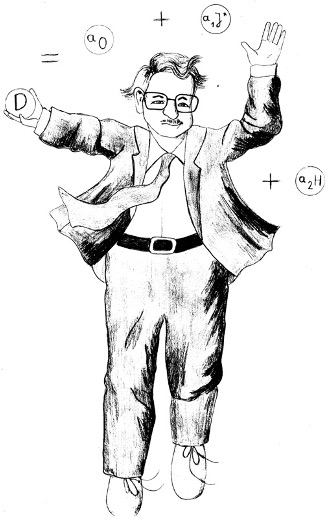
Drawing by illustrator Sabine Trafimow

Get the book


Meet 'Leaping Lou Pondy,' Enthinking with Boundless Quantum Energy


🌱 What Is Enthinkment?

Enthinkment is the practice of stepping outside habitual thought patterns, questioning assumptions, and engaging in deep reflection to uncover hidden biases and untapped possibilities.
Rooted in Martin Heidegger’s philosophy of mindfulness (Besinnung) and inspired by Louis Pondy’s challenge to bounded rationality, this tool helps leaders:

  • Sense what’s arriving before it’s named.
  • Break free from “stuck stories.”
  • Cultivate ethical, future-oriented leadership.

🔍 Why It Matters

Traditional management thought often relies on enactment—reactive storytelling and tactical ambiguity.
Enthinkment offers a deeper path:

Thinking Mode

Enactment (E2)

Enthinkment (E1)

Orientation

Retrospective

Prospective

Focus

Action-based

Reflective

Outcome

Political storytelling

Generative leadership


🛠️ What You'll Learn

  • The 3 Stages of Enthinkment: Reactive → Reflective → Generative
  • How to use the 7 B’s of Antenarrative to restory limiting beliefs
  • Practices like Zen Koan Inquiry, Mu-Ahimsa Silent Audit, and Booster Commitments
  • How to apply Heideggerian mindfulness to leadership and organizational development

📘 Who Should Join

  • Leaders seeking ethical, mindful transformation
  • Coaches guiding clients through deep reflection
  • OD Consultants designing change initiatives rooted in authenticity

🧠 Ready to Begin?

 [Enthinkment Study Guide]
Join the GrowthOD community in reclaiming the future of leadership—one mindful story at a time.

Scroll below or see the Tool 6 Training Manual for Leadership Enthinking


Basic Enthinking leadership mindmap


Open expanded Enthinking Leadership Mind Map in new page


🎬 The Enthinking Path to Mindfulness

(12minute Podcast)

Practitioner Guide to Enthinking Leadership

The practical tools of leader enthinkment are integrated into the Pondy Enthinkment Leadership Pathway (Tool 6), a framework designed to move organizational thinking beyond reactive, calculative decision-making toward generative reflection and ethical, future-oriented leadership.

These tools draw heavily on Martin Heidegger’s concept of mindfulness (Besinnung) and Louis Pondy’s challenge to bounded rationality.

The key practical tools and practices of leader enthinkment include:

I. The 7 B's of Antenarrative

The 7 B’s of Antenarrative serve as a foundational method used in the Reflection Guide on En-Think to uncover hidden biases, restory limiting beliefs, and facilitate the transition from Reflective to Generative Thinking.

7 Bs of Antenarrative form Boje and Saylors 2023
                book


1. Beneath (Story Filter): Leaders question the assertion’s attunement to concept, asking what core bias (e.g., historical paranoia) prevents them from seeing present competence.

2. Before (Facticity of History): Leaders identify where a perception originated, challenging reliance on precedent-based stories by inquiring into the facticity of history.

3. Bet (Prospective Sensemaking): This involves reframing decisions as learning experiences and making "bets on the future" based on communal values and growth, rather than fear.

4. Between (Transpection): Leaders analyze the space between the old belief and a more empowering future, applying transpection—translating the language of fear into the language of growth.

5. Becoming (Emergence): This is the fore-caring ethical process of emergence, focusing on how a story can be reshaped into an evolving narrative of learning and growth.

6. Being (Mindfulness/Inabiding): Leaders cultivate mindfulness in the present moment, trusting the signals that rise before words (Embodiment), and engaging in Heideggerian inabiding (Inständigkeit).

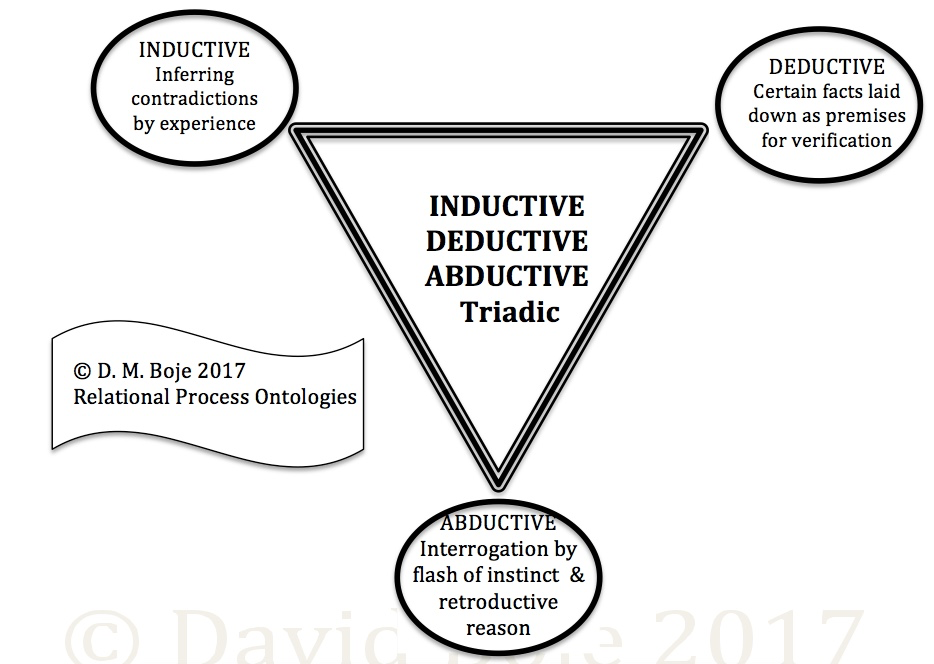
7. Beyond (Fore-Grasping Intuition): This involves making "wild guesses that need case study induction" (Peircean abduction), allowing the new story to transcend traditional limitations.

II. Leadership Exercises for Generative Thinking

The Pathway includes specific exercises designed to transition executives from using storytelling for political ends (terse telling/tactical ambiguity) to using it as an ethical, generative practice.

1. Koan-Based Pattern Sensing:

    ◦ Purpose: To shift thinking away from calculative, logical solutions toward embodied field attunement and sensing patterns, thereby bypassing the dualistic thinking inherent in bounded rationality.

    ◦ Example Inquiry: Leaders practice Louis Pondy's koan-like inquiry: "If we arrived in a new city, and didn’t know where to meet, where would you go to wait for me?".

    ◦ Process: Leaders silently attune (Mu) before strategizing, asking: "What patterns of fear are emerging in this conflict that we are not yet naming?".

2. Antenarrative Compactor Commitment (Booster):

    ◦ Tool: The Booster components are small, practical bets created by executives that integrate innovation and relational health.

    ◦ Purpose: To embed forward-sensing into practical action, making small, intentional gestures that counteract narratives like "paranoia ran high in this company".

    ◦ Example: A leader commits to mentoring someone younger weekly or seeking peer feedback to demonstrate that competence is valued, not feared, reinforcing the Becoming antenarrative.

3. Embodied Restorying and Silent Audit:

    ◦ Tool: Mu-Ahimsa Silent Audit.

    ◦ Purpose: To move from shallow, political storytelling (enactment) to True Storytelling predicated on unconcealment.

    ◦ Process: Leaders sit in silence before or after a contentious meeting to reflect on hidden suffering or relational shadows. They apply Ahimsa (a Jain principle meaning ontological listening or perceiving the other without harm), holding "cruelty, care, and healing together" to perceive directly, without assumption (Preksha).

III. Supporting Mindfulness and Reflection Practices

Enthinkment also encourages the application of broad philosophical and leadership practices to cultivate deeper awareness:

 Heideggerian Mindfulness (Besinnung): The underlying philosophical root of enthinkment, which involves a meditative, ontological engagement with the truth of be-ing (Seyn), rather than calculative reasoning.

 Together-Listening: A co-creative act in which executives collectively sense emerging truths, moving beyond manipulating narratives for political gain.

 Bring Mind Back In: An effort to engage in deeper reflection, contrasting with bounded rationality's focus on superficial cognitive processing.

 Artist Attention: A form of creative, embodied sensing that is attuned to emergence, replacing traditional reliance on diagnosis and analytics.

 Vichara: The Jain principle of critical self-inquiry, used alongside Ahimsa.

 Remote-Control Reflection: A practice used during the generative stage to embrace full humanity and compassionately hold tension and shadow.


🔗 Tool 7: SEAM Integration – The Socio-Economic Storytelling Toolkit

The Integrator's Voice: "All the voices must come together—no tool works in isolation." SEAM (Socio-Economic Approach to Management) weaves rigorous financial diagnosis with all six previous storytelling tools into one comprehensive intervention methodology. While Tools 1-6 give you distinct voices for mapping, diagnosing, navigating, mediating, tracking, and philosophizing, SEAM is the meta-framework showing how they interconnect. It reveals the hidden costs your client can't see in traditional accounting—averaging $20,000-$80,000 per employee annually—and converts organizational dysfunctions into measurable economic performance through ensemble storytelling. This isn't just consulting; it's scientific intervention-research tested across 2,150+ organizations in 48 countries since 1974. You're conducting polyphonic organizational change that simultaneously addresses social and economic performance. Want the full SEAM methodology? This tool gives you enough to start the conversation—book a free 30-minute Zoom with Dr. David Boje at growthOD.org to go deeper.

Tool 7: SEAM Storytelling Integration Tool – A Coaching Guide for Restorying Organizational Dysfunction

Basics of SEAM See Study Guide PDF

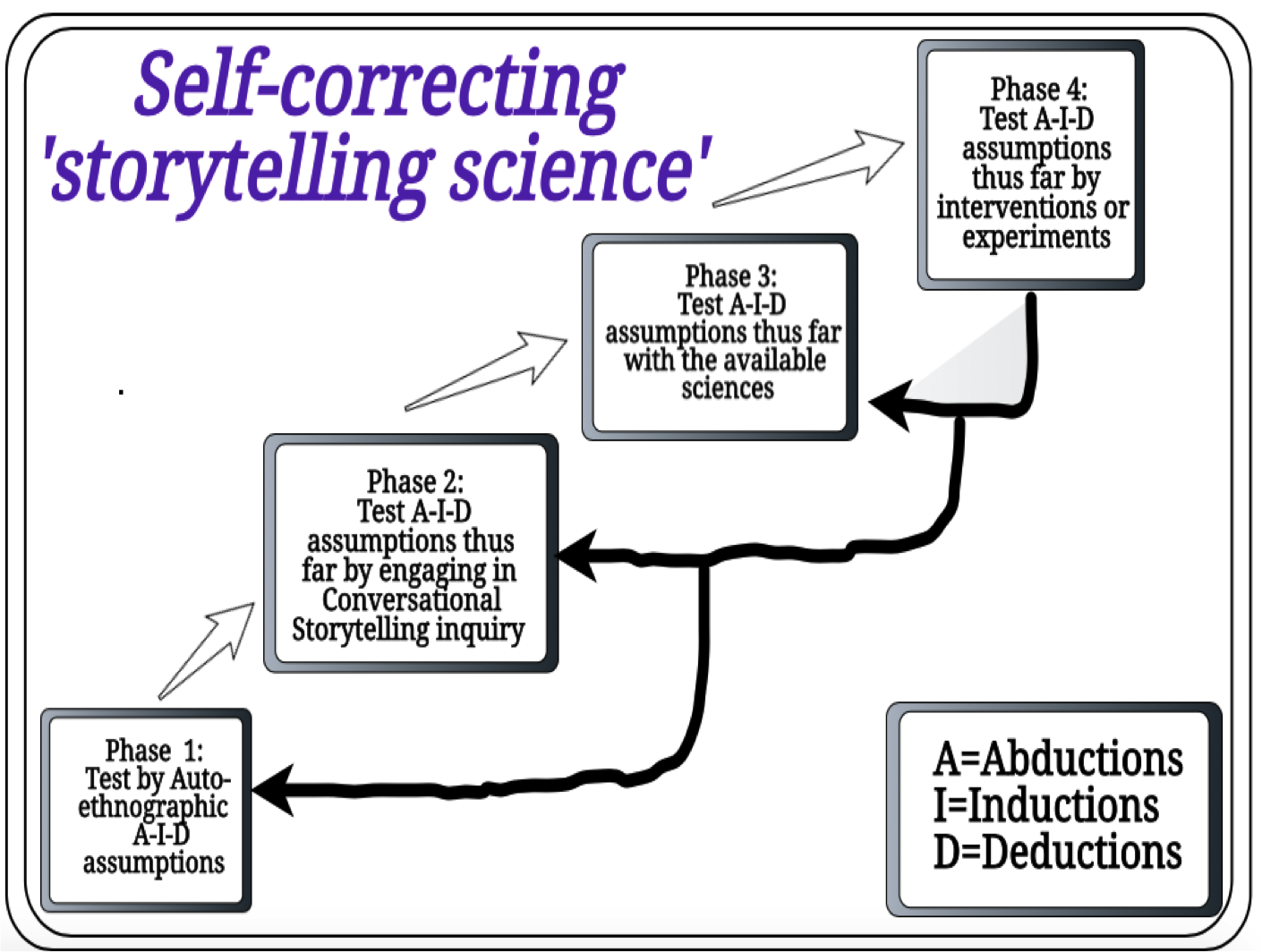
SEAM and STORYTELLING are intertwined. Humans are hard-wired for story. Story Work is accelerated when researchers oblige themselves (or are obliged) to exteriorize themselves in story conversation or in writing (principle of cognitive interactivity” (Savall & Zardet, 2008: 145, 148, note I (Boje) reversed order of last two steps, and changed wording of the steps):

    1. Exploration in Diagnostic phase of DPIE
    2. Conceptualization In-Depth Observation
    3. Modelization
    4. Experimentation by implementing co-created projects (horizontally and vertically, in HORIVERT).
    5. Evaluation
    6. Formulation of relevant and knowledge to be disseminated
    7. Validation

In taking verbatim field notes, making observations (& transcribing interviews & meetings) the researcher-intervenor can detect just how disorganized the theatrics of the organization have become. The SEAM Mirror Effect enables the client to confront organizational dysfunctions and hidden costs before project planning. In this way, the client can spend a moderate amount on the change intervention in order to save a major and significant amount in achieving greater socio-economic and financial performance, improving working conditions, and developing a democratic participation of project teams


A diagram of a diagram of a diagram AI-generated
              content may be incorrect.

SEAM's Four Leaf Clover

Upper Leaf of Dysfunction Categories

SEAM classifies dysfunctions using the Cloverleaf Model

1.     Work Conditions
Unsafe environments, outdated equipment, ergonomic strain, or psychological stressors.

2.     Work Organization
Role ambiguity, redundant processes, overcontrol, or under-delegation.

3.     Three Cs of Communication- Coordination-Cooperation
Missing feedback loops, email overload, secrecy, or over-formalized reporting.

4.    Time Management
Are people spending time in value added ways (what Axiogenics calls 'net value')?

5.   Training 
Are people trained in what brings 'net value'? Are people in need of training getting the training they need?

6.   Strategic Implementation
Often, organizations are so busy putting out fires in the first five dysfunctions that people are not engaging in strategic implementation.

The upper leaf  dysfunctions are entangled

Yue Cai Hillon mapping socioeconomic dysfunctions

A more spiral view of the entanglement in over time.

Yue Cai Hillon spiral mapping of dysfunctions


💰 The Hidden Costs

Over 50% of business costs are hidden from accounting reports—and 40% are buried under trauma memories and stuck thoughts that PERVIEW is designed to address.

•Disconnection from Organizational Story and Values: Millennials often seek purpose-driven work environments. A lack of alignment with company values can lead to disengagement.

•Lack of Communication, Coordination, and Cooperation (3 Cs): Ineffective communication and collaboration structures can hinder millennial's' sense of belonging and contribution.

•Burnout, Misalignment, and Unprocessed Trauma: High expectations without adequate support can result in burnout and emotional exhaustion.

Savall and Zardet (2008) argue that dysfunction is not accidental—it becomes routinized. Dysfunction becomes normalized, repeated in behaviors, systems, and habits. This repetition conceals the financial damage beneath a mask of familiarity. Here, storytelling isn’t decorative—it’s diagnostic.

To fully grasp this, Boje (2025) brings in post-structural theories, particularly Deleuze and Guattari’s concept of the rhizome. In SEAM’s adaptation, dysfunctions are not linear problems with linear solutions. Rather, they form rhizomatic webs—interconnected, subterranean systems of meaning, behavior, and consequence.


A diagram of a diagram AI-generated content may be
              incorrect.

SEAM has three Spirals

A-Spiral is the intervention of three or more successive rounds of D-P-I-E (Diagnosis-Project planning-Interventions-Evaluation). DPIE teams are lunched across the organization with the goal of DIAGNOSIS, identifying hidden costs, root causes of weak socio-economic financial performance. PROJECT PLANNING to recycle hidden costs into new revenue streams by unleashing Human Potential. IMPLEMENTATION means getting the job done right, by innovating, being intrapreneurs. Then comes the EVALUATION of qualitative, quantitative, and financial outcomes (known as Qualimetrics).

dpie-cycle

dpie-times-3-spiral

Figure 3: Implementing successive DPIE’s (Diagnosis-Project Design-Implementation-Evaluation cycles) to rebuild NMSU Momentum

B-Spiral is the six SEAM Tools that are taught to the DPIE team members.

C-Spiral Five Strategic Decisions

Growth OD method of Socio-Economic Approach to Management (SEAM) is designed to be holistic framework for organizational development and change that integrates narrative analysis, systems thinking, and strategic intervention. SEAM’s methodology aligns closely with the five strategic decision areas you listed, offering a dynamic, participatory approach to transformation.

1. Change Technology

·       SEAM Perspective: SEAM recognizes technology as an “actant” that mediates human routines and organizational habits. Rather than treating technology as a separate or purely technical issue, SEAM situates technology within the broader ecology of routines and the “ensemble of multiplicities.” This means technological change is always embedded in, and must be co-evolved with, human practices, stories, and organizational culture.

·       Application: SEAM consultants diagnose how technology shapes routines and where dysfunctions or hidden costs arise, then co-create interventions that integrate new technologies with changes in work practices and narratives.

2. Change Procedures

·       SEAM Perspective: Procedures are viewed as routinized behaviors that can become dysfunctional over time. SEAM intervenes by uncovering the “living stories” behind these routines, making visible the often-hidden costs and inefficiencies that standardized procedures may create.

·       Application: Through participatory diagnosis and the “mirror effect,” SEAM helps organizations re-story their procedures, shifting from passive repetition to agile, reflective practices that support strategic goals.

3. Change Products/Markets

·       SEAM Perspective: SEAM connects internal change to the external environment, including products and markets. Strategic decisions about products and markets are not isolated; they are woven into the organization’s stories, competencies, and collective sensemaking.

·       Application: SEAM’s diagnostic process includes both internal and external analyses, linking changes in products/markets to shifts in routines, competencies, and the broader organizational narrative.

4. Change Management System

·       SEAM Perspective: Management systems are seen as dynamic, evolving structures. SEAM emphasizes democratic participation, distributed leadership, and the development of “ensemble leadership” rather than top-down control.

·       Application: SEAM interventions often involve redesigning management systems to foster communication, cooperation, and coordination (the “3 C’s”), supporting a shift from micromanagement to empowerment and agility.

5. Develop Human Potential

·       SEAM Perspective: Developing human potential is central to SEAM’s philosophy. The approach seeks to uncover and release untapped capacities by addressing dysfunctions, hidden costs, and disempowering routines.

·       Application: SEAM uses tools like competency grids, participatory training, and negotiated activity contracts to align individual growth with organizational objectives, creating an upward spiral of socio-economic progress.


The Three Epistemological Pillars of SEAM


To move from representation to transformation, we must integrate storytelling into the three SEAM concepts: Cognitive InteractivityContradictory Intersubjectivity, and Generic Contingency (Savall & Zardet, 1996)—each of which supports the whole arc of organizational transformation using a triple-loop learning model.

A diagram of a company AI-generated content may be
                incorrect.

1. Cognitive Interactivity: Unlocking Collective Intelligence

Organizations are made of people—and people make meaning through stories. Each actor interprets and tells stories about organizational reality differently, based on their history, role, training, and lived experience. Dr. Amandine Savall gives the following example (Sep 29, 2025, Click here for her YouTube Presentation), which I summarize in this table:

State

Description

Level of Stability

Gas

This represents the initial, unstable ideas, thoughts, and feelings people have in their heads. Like gas, these thoughts are diffuse and can change from one moment to the next.

Highly Unstable

Liquid

This is the act of talking and expressing ideas. When people speak, they "liquidify" the gas, giving it form and making it more stable than a fleeting thought.

Moderately Stable

Solid

This is the act of writing those expressed ideas down on a flip chart or paper. By making ideas physically visible, they become "solid"—stable and accessible for the entire group to see, discuss, and build upon.

Highly Stable


Cognitive Interactivity refers to the structured processes through which these differences are surfaced, understood, and synthesized through this methods:

  • Story Circles
  • Focus Groups
  • Mirror Effect Meetings
  • Intervention Projects
  • Move to Triple Loop and Ensemble Leadership

These dialogic spaces enable single-loop (compliance-focused on command-and-control) and double-loop (root cause-focused on open systems) learning, which initiates triple-loop transformation, where the system itself is restructured and coordinated through Ensemble Leadership practices (Rosile, Boje, & Claw, 2018; Boje & Rosile, 2024, 2025a).

In Triple Loop learning:

  • Single-loop = reacting within the rules of the command-and-control hierarchy.
  • Double-loop = double system of cybernetic deviation-control with deviation-amplification (agility, experimentation, participative processes, intrapreneurship, innovation).
  • Triple-loop = a loop of ensemble leadership networking for coordination of single and double loop by creating a loop of heterarchy.

This third loop requires what we call Ensemble Leadership—a shift from command-and-control to a decentralized, networked, and ethically accountable culture where everyone is the leader of something (Rosile, Boje, & Claw, 2018; Boje & Rosile, 2024, 2025).

Heterarchy means everyone is a leader of something. Heterarchic leadership is decentered, rather than centralized, and operates through non-linear networks rather than hierarchies. It is egalitarian rather than top-down, with leadership being shared and distributed, rather than reserved solely for the C-suite, where leader privileges are held. The concept of heterarchy, central to ensemble leadership, encompasses both identifying leadership functions and promoting egalitarianism. In sum, instead of a rigid hierarchical pyramid, ensemble leadership in Triple Loop transformations suggests a more fluid and networked structure where leadership is distributed and shared among individuals, fostering a more egalitarian environment. In Triple Loop launching and coordinating cascading D.P.I.E. (Diagnostic, Project planning, Implementation, Evaluation of results) teams is key to sustaining continuous improvement.

Through Ensemble Leadership, DPIE teams (Diagnosis, Planning, Implementation, Evaluation) cascade change initiatives that are self-correcting and root-cause oriented.

2. Contradictory Intersubjectivity: Navigating the We-Space

Intersubjectivity refers to the shared space of meaning that forms between people in real-time interactions. In practice, this is the arena where:

  • Perspectives clash and harmonize
  • Assumptions are surfaced
  • A new "we" story is negotiated

This is not a superficial consensus but a quantum energetic field of story entanglement—where each person’s narrative affects the other. Contradictory Intersubjectivity is defined here as the invisible ‘quantum energy field’ generated by actor relationships—the energy, resonance, and mutual attunement to context that shape how people feel, think, and act together. It’s where values, norms, and collective narratives are negotiated and lived. From a quantum storytelling perspective (Boje & Sanchez, 2019), intersubjectivity refers to the entanglement of stories—how one person’s narrative resonates with another’s, creating ripples that shape organizational reality in unpredictable, emergent ways. As Garfinkel (1967) and Boje (1995) illustrate, even in the same room, two people may walk away with entirely different stories due to their unique paths through the organizational maze.

Harold Garfinkel (1967), the founder of ethnomethodology, a field of sociology that studies the methods people use to make sense of and navigate their social world, provides an example of a husband and wife interaction in his work. The husband and wife rely on shared understandings and assumptions to make sense of their everyday conversations.  Example: A husband and wife are having a conversation, and the husband says:  "Dana succeeded in putting a penny in a parking meter today without being picked up."  The wife responds with:  "What for?" The husband clarifies: "No, to the shoe repair shop." This excerpt demonstrates how spouses rely on shared context and implicit understanding to interpret each other's remarks. The wife's initial question "What for?" reveals her knowledge of the context, suggesting she's thinking of the reason for putting money in a parking meter, likely related to parking for an errand. The husband's clarifying response "No, to the shoe repair shop" further elaborates on the scenario, indicating where they went and why Dana would need to reach the meter (as they were parked there while going to the shoe repair shop). Here is the entire exchange form Garfinkel (1969):

A screenshot of a text message AI-generated content
                may be incorrect.

The conversation unfolds based on these shared understandings and assumptions, illustrating the subtle but essential role of everyday methods in making sense of social interactions. This example highlights a key concept in ethnomethodology: indexicality, which refers to how the meaning of words and actions is dependent on the context in which they occur. The husband's statement "Dana succeeded in putting a penny in a parking meter today without being picked up" is indexical because its full meaning relies on shared knowledge about Dana, the parking meter, and the husband and wife's activities that day. Their ability to successfully communicate and understand each other's remarks stems from their mutual reliance on this shared background knowledge. The implication is that the social order of a family and any organization is not simply a pre-existing structure but is constantly and actively co-produced through storytelling and sense-making methods in everyday interactions. Example: firefighters and police officers must be able to quickly interpret indexical cues from a scene, such as the behavior of individuals, the appearance of the environment, and communication with other responders, to understand the situation and make informed decisions. In essence, Garfinkel uses this and similar examples to demonstrate that social order and understanding are not pre-existing structures but are constantly and actively produced through the methods people employ in their everyday interactions. 


To resolve contradictory intersubjectivity:

  • SEAM uses co-inquiry methods: Interviews, observation, document analysis, and stakeholder dialogues.
  • Leaders foster ensemble conversations that prioritize attunement over authority.

Why it matters for organizations:

  • Better Decisions: emerge from dialogic resonance, not individual assertion.
  • Sustainable Change: grows from co-created story, not top-down mandates.
  • Adaptive Leadership: thrives through sensemaking-in-action, not rigid roles.

This is where PERVIEW Coaching integrates with SEAM—training leaders to read and respond to the “energy field” of meaning, emotion, and momentum within a team or system.

3. Generic Contingency: Building a Science of Story-Driven Change

Organizations operate in unpredictable environments. SEAM introduces scientific rigor through Generic Contingency—a process rooted in Charles Sanders Peirce’s logic of discovery:

  • Abduction: What is surprising? What doesn’t fit the current story? Making a guess about a hypothesis that needs more inductive cases and theory building.
  • Deduction: If this hypothesis is true, what else would we expect to see in inductive cases?
  • Induction: What patterns emerge from actual cases? Does the evidence hold? What if there is a black swan effect, and all swans are not white?

Given Contradictory Intersubjectivity, and the need for Cognitive Interactivity to create shared understanding and action, the scientific part involves generating self-correcting co-inquiry by applying Charles Sanders Peirce’s Induction, Deduction, and Abduction (Boje & Rosile, 2020).

AID triad see Boje and Rosile 2020 for more on
                this

Abduction is the initial stage where a surprising fact or observing something unexpected.  Abduction “an argument or supposition that assumes it was a case of a general rule and of results that still needs actual inquiry (Peirce, 1931-1935, vol. 2: p. 515, 624). Such abduction, the formation of a wild or informed guess, needs induction method, the gathering of cases. Abduction can become the basis for a hypothesis.

Deduction involves drawing out the logical consequences of the abduction and hypothesis. Deduction “belongs to general class of results by theory-arguments that in the long run tend toward the truth of case results”  (Peirce, 1931-1935: vol 2: p. 266). If the hypothesis is true, what else should also be true?  It does not generate new knowledge; rather, it clarifies the implications of existing assumptions. 

Induction is the process of testing the hypothesis by gathering cases. Induction “generalizes from a number of cases and results, of which something is true, to infer some rule for the whole population” (Peirce, 1931-1935, vol. 2: p. 624). If cases support the deduction and abduction (or hypothesis, it becomes more credible.

Boje and other researchers in fields like clinical medicine and artificial intelligence see the three modes of reasoning as a dynamic, integrated cycle rather than isolated steps. The process unfolds as follows: 
  1. Abduction: A researcher encounters a puzzling situation and uses abductive reasoning to form a plausible working hypothesis to explain it.
  2. Deduction: The researcher uses the working hypothesis to deduce specific, testable predictions.
  3. Induction: The researcher conducts tests or gathers more data to see if the predictions hold true, allowing for the correction or refinement of the initial theory.
  4. Repeat: The newly refined theory can then be subject to more rounds of abductive, deductive, and inductive analysis, leading to a more robust and accurate understanding

Self-correcting phases with tests to improve your
              abductive propositions and your inductive tests and your
              deductive theorizing along your journey

The self-correcting phases conduct various inductive tests that realize deductive theory corrections and corrections to abductive propositions (or hypotheses). This next image is an example of self-correcting 'storytelling science' method from our three year study of the Coalition of Immokalee Workers (Rosile, Boje, Sanchez, & Herder, in press 2019).

Rosile, Grace Ann; Boje, David M.’ Herder, Rick; Sanchez, Rick. (2019, in press).  The Coalition of Immokalee Workers uses Ensemble Storytelling Processes to Overcome Enslavement in Corporate Supply Chains. This is earlier draft of article accepted by Business and Society Journal, July 2019. Click here for PDF draft version.

Boje, David M.; Rosile, Grace Ann. (2019). 'Conversational Storytelling Research Methods: Cats, Dogs, and Humans in Pet Capitalism. Communication Research and Practice journal. Accepted Oct 9, 2019. Click here for pre-publication PDF.

For another example, please see

Boje, David M.; Rosile, Grace Ann. (2019). 'Conversational Storytelling Research Methods: Cats, Dogs, and Humans in Pet Capitalism. Communication Research and Practice journal. Accepted Oct 9, 2019. Click here for pre-publication PDF.
Our CIW study using self-correcting storytelling science
          phases

Coalition of Immokalee Workers (CIW). We began the CIW pre study with an Ensemble Leadership Theory (accepted 2016, finally in print in 2018: Rosile, Grace Ann; Boje, David M.; Claw, Carma. (2018). “Ensemble Leadership Theory: Collectivist, Relational, and Heterarchical Roots from Indigenous Contexts.” Leadership journal, Vol. 14(3) 307–328.  CLICK HERE for online prepublication draft, or here for PDF from Sage We then used self-correcting method to change the auxiliary assumptions (Trafimow, 2012) that we applied in the Inductive Tests (autoethnogrpahies, participant observation, conversational interviews, archival studies, etc.).


 Boje (2003), intro to Qualimetics, addresses how measurement before and after, each and every change intervention experiment, is fundamental to Savall's socioeconomic approach to management, known as SEAM. It is not only quantitative and financial, but also the researcher-intervenor (Savall does not use terms like action researcher or change agent). The qualitative component includes the researcher-intervenor collecting verbatim qualitative field notes and direct observations, then entering them in a SEAM diagnostic computer data bank, that can be analyzed for each 'Mirror Effect' meeting with the client, when the quantitative (hidden costs), financial data, and qualitative quotes from all stakeholders is 'mirrored back' to the client, so they can see what it is costing the organization to remain dysfunctional, not converting hidden costs and revenues into realizable economic performance. When Grace Ann Rosile and I and interviewed Henri Savall and wrote an article about it we discovered something important, not in any of the Savall books. That is, Savall views the qualitative discourse of an organization as a theater script that is disorganized and dysfunctional. We call this the 'Theatrics of SEAM' (Boje & Rosile, 2003).

12. Conclusion
SEAM reframes budget stress from scarcity to design: the money to improve the system is already inside the system, leaking through avoidable dysfunctions. When NMSU’s people co‑diagnose, co‑design, and co‑evaluate, they recover dollars and dignity together.  SEAM counters the typical TFW virus that infects most organizations.

TFW
                virus

In its place, the SEAM consulting, coaching, and training methodology transforms the organization by developing human potential, launching DPIE teams to effect interventions that transform dysfunctions into untapped revenue streams.


SEAM at NMSU — Quantifying Hidden Costs and Designing DPIE Turnarounds

By David M. Boje, PhD, September 28, 2025

Abstract — This essay by Dr. David Boje integrates the Socio‑Economic Approach to Management (SEAM) with GrowthOD/PERVIEW to focus on the NMSU case. It distills the scientific logic, the diagnostic ‘cloverleaf’ of dysfunctions, and the qualimetric calculations used to convert hidden costs into targeted, self‑financed interventions. Boje’s contribution is Tool 7: SEAM Storytelling Integration GrowOD Tool by Dr. David Boje https://GrowOD.com

Purpose: This essay by Dr. David Boje integrates the Socio‑Economic Approach to Management (SEAM) with GrowthOD/PERVIEW to focus on the New Mexico State University (NMSU) case. It distills the scientific logic, the diagnostic ‘cloverleaf’ of dysfunctions, and the qualimetric calculations used to convert hidden costs into targeted, self‑financed interventions. We foreground the NMSU hidden-cost grid, walk through the calculation methods, and offer step-by-step practitioner guides for DPIE (Diagnosis–Project planning–Implementation–Evaluation) teams, Mirror-Effect meetings, Priority Action Plans (PAPs), Competency Grids, and Periodically Negotiated Activity Contracts (PNACs). Two figures visualize the NMSU cost structure and potential recovery levers.


Watch 10 Minute Youtube by Dr. David Boje summarizing this page and its case study


Tool 7 SEAM mind map


Open expanded SEAM Mind Map in new page


🎬 What is SEAM? 

(17 minute Podcast)


💰SEAM at NMSU: Quantifying Hidden Costs and Designing Turnarounds

Introduction to SEAM

I taught SEAM at New Mexico State University (NMSU) for 20 years at the undergraduate, master’s, and PhD course levels. Each summer, Dr. Grace Ann Rosile and I went to Lyon, France, to work with Henri Savall, Veronique Zardet, Marc Bonett, and Amandine Savall, teaching summer courses there. In most organizations, energy is leaking from the system, silently.

What Grace Ann and I learned? There is a 50% leak in hidden costs. This leak doesn’t show up in quarterly earnings or polished dashboards—but in absenteeism, turnover, poor coordination, demoralized teams, and wasted time. SEAM—Socio-Economic Approach to Management—makes this invisible visible.

3. NMSU Case: From Downward Spiral to SEAM Turnaround
Dr. David Boje documented a period when NMSU experienced attrition, role overload, and a reliance on short‑term spreadsheet analysis rather than participatory diagnosis. The result was a costly downward spiral: understaffing, overwork, burnout, and reputational risk. The SEAM alternative modeled below shows how to quantify and then recycle these costs into capability building. Table 1 reproduces the NMSU hidden‑cost grid as modeled in the source chapter; Figures 1–2 visualize the same data to guide practitioner prioritization.

Table 1. NMSU HiddenCost Grid by Dysfunction and Cost Type (USD)

Dysfunction

Over-salary

Excess Time

Over-compensation

Non-production

Non-creation of Potential

Total

Absenteeism

$600,000

$300,000

$500,000

$1,000,000

$500,000

$2,900,000

Accidents

$70,000

$200,000

$100,000

$200,000

$300,000

$870,000

Turnover

$200,000

$100,000

$600,000

$300,000

$900,000

$2,100,000

Non-Quality

$400,000

$300,000

$400,000

$2,000,000

$800,000

$3,900,000

Productivity Variance

$900,000

$600,000

$700,000

$300,000

$800,000

$3,300,000

TOTAL

$2,170,000

$1,500,000

$2,300,000

$3,800,000

$3,300,000

$13,070,000


Figure 1. NMSU – SEAM Hidden Costs by Dysfunction Category (stacked components)

A graph of different colored bars AI-generated
              content may be incorrect.


Figure 2. NMSU – Total Hidden Costs by Category

A graph of a bar chart AI-generated content may be
              incorrect.

Reading the NMSU Numbers: What the Grid Says
The totals by dysfunction category are striking. Non‑Quality (≈$3.9M) and Productivity Variance (≈$3.3M) lead the losses, closely followed by Absenteeism (≈$2.9M) and Turnover (≈$2.1M), with Accidents the smallest category (≈$0.87M). Across cost types, Non‑production (≈$3.8M) and Non‑creation of Potential (≈$3.3M) dominate, revealing structural under‑utilization of talent and systemic process delays rather than individual ‘performance issues.’ SEAM’s point is not to blame; it is to re‑design. Each dollar of avoidable loss can be self‑financing ‘fuel’ for Priority Action Plans (PAPs) that improve working conditions, clarify roles and procedures, strengthen the 3Cs, and restore strategic implementation cycles.

What are the potentialities if NMSU engaged in SEAM?

Here is a SEAM project for sustainability that David Boje proposed to NMUS. NMSU, you as Living Story Leaders, Can Help NMSU become a signatory to the 17 UN Sustainable Development Goals. Pick a department or college, or whole university and use SEAM to get them to be a signatory of the UN SDG's.

Figure: Placing New Mexico State University within the 17 UN SDG's

HIGHER EDUCATION SUSTAINABILITY INITIATIVE

The Higher Education Sustainability Initiative (HESI), is a partnership of UN agencies and initiatives that have teamed up to to provide a platform for Higher Education Institutions to engage and contribute to the UN Sustainable

Development Goals, enabling the exchange of best practices and educating future leaders on sustainable development.

All higher education institutions may join the network freely. Higher education institutions part of HESI commit to:

  1. Teach sustainable development across all disciplines of study,
  2. Encourage research and dissemination of sustainable development knowledge,
  3. Green campuses and support local sustainability efforts, and
  4. Engage and share information with international networks.

Join by filling in the online application under “Register Initiative” https:// sustainabledevelopment.un.org/ partnerships/hesi 

There are more than 300 higher education institutions from all over the world that are members of HESI. NMSU could be #301, and #1 in New Mexico.

References

Comprehensive bibliography of foundational works in organizational storytelling, antenarrative theory, and socio-economic management approaches.

Bakhtin, M. M. (1981). The dialogic imagination (C. Emerson & M. Holquist, Trans.). University of Texas Press.

Bakhtin, M. M. (1984). Problems of Dostoevsky’s poetics (C. Emerson, Ed. & Trans.). University of Minnesota Press. https://monoskop.org/images/1/1d/Bakhtin_Mikhail_Problems_of_Dostoevskys_Poetics_1984.pdf

Boje, D. M. (1991a). The storytelling organization: A study of story performance in an office supply firm. Administrative Science Quarterly36(1), 106–126. https://GrowthOD.org/Boje-1991-ASQ-article-Office-Supply.pdf

Boje, D. M. (1991b). Consulting and change in the storytelling organization. Journal of Organizational Change Management4(3), 7–17. https://growthod.org/Consulting-the-storytelling_organization.pdf

Boje, D. M. (1995). Stories of the storytelling organization: A postmodern analysis of Disney as “Tamara-Land.” Academy of Management Journal38(4), 997–1035. https://davidboje.com/vita/paper_pdfs/AMJ_Disney.pdf

Boje, D. M. (2001). Narrative Methods for Organizational & Communication Research. SAGE.  https://www.google.com/books/edition/Narrative_Methods_for_Organizational_Com/4eyxoiqtUwoC?hl=en&gbpv=1&pg=PA1&printsec=frontcover
Boje, D. M. (2007). The antenarrative turn in narrative studies. Communicative practices in workplaces and the professions: Cultural perspectives on the regulation of discourse and organizations, 219-237.

Boje, D. M. (2008). Storytelling organizations. Sage. https://www.google.com/books/edition/Storytelling_Organizations/xpJU3tMh0r4C?hl=en&gbpv=1&pg=PP2&printsec=frontcover

Boje, D. M. (2012a). Reflections: What does quantum physics of storytelling mean for change management?. Journal of Change Management12(3), 253-271.  https://www.tandfonline.com/doi/full/10.1080/14697017.2011.609330#d1e250

Boje, David M. (2012b). "Tales from the Quantum Storytelling Field." https://davidboje.com/quantum/pdfs/Boje%20Tales%20from%20the%20Quantum%20Storytelling%20Field.pdf

Boje, David M. Storytelling organizational practices: Managing in the quantum age. Routledge, 2014.https://davidboje.com/vita/paper_pdfs/Sampe%20STORYTELLING%20Practics%20boje.pdf

Boje, D. M. (2014). Storytelling organizational practices: Managing in the quantum age. Routledge. https://davidboje.com/vita/paper_pdfs/Sampe%20STORYTELLING%20Practics%20boje.pdf

Boje, D. M. (2018). Organizational research: Storytelling in action. Routledge. https://www.google.com/books/edition/Organizational_Research/VnxqDwAAQBAJ?hl=en&gbpv=1&pg=PP14&printsec=frontcover

Boje, D. M. (2019). Storytelling organization” is being transformed into discourse of “digital organization. M@ n@ gement22(2), 336-356. https://davidboje.com/vita/paper_pdfs/MANAGING%20j%20Storytelling%20Organization%20is%20Being%20Transformed%20into%20Discourse%20of%20Digital%20Organization.pdf

Boje, D. M. (2021). Storytelling and Cybersemiotics. In Introduction to Cybersemiotics: A Transdisciplinary Perspective (pp. 421-443). Cham: Springer International Publishing. https://davidboje.com/vita/paper_pdfs/Storytelling%20and%20Cybersemiotics%20chapter%20for%20Brier%20book.pdf

Boje, D. M. (2024a). True Storytelling Antenarrative-Processes and the Existential-Ethics Turn. In A World Scientific Encyclopedia of Business Storytelling Set 2: Methodologies and Big Data Analysis of Business Storytelling Volume 1: Business True Storytelling (pp. 43-58). https://www.google.com/books/edition/A_World_Scientific_Encyclopedia_Of_Busin/wGMOEQAAQBAJ?hl=en&gbpv=1&pg=PA43&printsec=frontcover

Boje, D. M. (2024b) Corporate Truth, Time, Technology, and Thinking About our Existence. https://antenarrative.com/Organizational%20Change%20and%20Primordial%20%20BOJE%20Jan%206%202024.pdf

Boje, D. M. (2025a). Tamara revisited: PERVIEW, SEAM, and the storytelling challenge of the digital multiverse. Tamara: Journal of Critical Organizational Theory. Advance online publication. https://growthod.org/Tamara%20Revisited%20essay%20David%20Boje%20Jun%205%202025.pdf

Boje, D. M. (2025b). Scholar's Introduction to Polyphony Errors in Tamaraland these tools address. https://GrowOD.com/%F0%9F%93%9A%20Comparison%20and%20Contrast%20of%20Bakhtin.pdf

Boje, D. M., Haley, U. C., & Saylors, R. (2016). Antenarratives of organizational change: The microstoria of Burger King’s storytelling in space, time and strategic context. human relations69(2), 391-418. https://journals.sagepub.com/doi/abs/10.1177/0018726715585812
Boje, D. M., & Henderson, T. L. (Eds.). (2014). Being quantum: Ontological storytelling in the age of antenarrative. Cambridge Scholars Publishing. https://www.google.com/books/edition/Being_Quantum/bylQBwAAQBAJ?hl=en&gbpv=1&dq=boje,+david+%27antenarrative%27&pg=PR5&printsec=frontcover

Boje, D. M., & Parr-Rud, O. (2025). GROWTH OD: Gratitude-Rooted Organizational Wisdom, Transformation & Healing. Tamaraland Publishing.

Boje, D. M., & Pelly, R. D. M. (2025). Return to Tamara-Land: A methodological exploration of the antenarratives of tyrannic capitalism. International Journal of Business Communication. Advance online publication. https://growthod.org/David%20and%20Duncan%20Article%20on%20Tamaraland%20of%20Peltz%20Disney.pdf

Boje, D. M., & Rosile, G. A. (2025). Disney's proxy battles reveal the dark side of leadership storytelling: And we offer restorying way out. In A. Rixon (Ed.), Organizational storytelling. Routledge. (Pre-press chapter). https://growthod.org/BojeRosile%20vers%202%20DarkSide%20of%20Leadershp%20Chapter%20in%20submission.pdf

Boje, D. M., & Rosile, G. A. (2025). PerView Coaching Manual: Processes of Embodied Restorying and VIEW. PerView.org Publications.

Boje, D. M., Rosile, G. A., & Gardner, C. L. (2004, August). Antenarratives, narratives and anaemic stories. In paper for the All Academy Symposium Actionable Knowledge as the Power to Narrate, New Orleans: New Orleans meeting of the Academy of Management (Vol. 9). https://davidboje.com/McD/papers/2004%20boje%20rosile%20Gardner%20Academy%20presentation%20Antenarratives%20Narratives%20and%20Anaemic%20ones.pdf 

Boje, D. M., & Svane, M. S. (2015). Tamara Land, fractal change management: In between managerialist narrative and polyphonic living stories. Proceedings of the Sc. MOI Conference. Retrieved from https://vbn.aau.dk/ws/portalfiles/portal/225730097/Tamara_Land_Fractal_Change_Manage ment_Las_Vegas_Paper.pdf
Boje, D. M., & Svane, M. (2017). Anticipatory knowledge: an antenarrative perspective on TrumpLand and the future of higher education. In 33 rd EGOS Colloquium: The Good Organization, Copenhagen. https://davidboje.com/vita/paper_pdfs/FINAl%20Anticipatory%20Knowledge%20in%20TrumpLand%20for%20EGOs.pdf

Boje, D. M., Svane, M., & Gergerich, E. M. (2016). Counternarrative and antenarrative inquiry in two cross-cultural contexts. European Journal of Cross-Cultural Competence and Management4(1), 55-84. https://davidboje.com/vita/refjrnl/Nov%2025_R%20andR_Counternarrative_and_Antenarrative%20Inquiry%20in%20Two%20Cross-Cultural%20Contexts.pdf

Bülow, A. M., & Boje, D. M. (2015).The antenarrative of negotiation: On the embeddedness of negotiation in organizations. Journal of Strategic Contracting and Negotiation1(3), 200-213. https://research-api.cbs.dk/ws/files/44523741/anne_marie_b_low_the_antinarrative_of_negotiation_postprint.pdf

Cai-Hillon, Y., Boje, D. M., & Dir, C. (2011). Strategy as antenarrative complexity. In Storytelling and the Future of Organizations (pp. 163-175). Routledge. https://www.google.com/books/edition/Storytelling_and_the_Future_of_Organizat/wvurAgAAQBAJ?hl=en&gbpv=1&pg=PA163&printsec=frontcover

Demarest, P. D., & Schoof, H. J. (2011). Answering the central question: How science reveals the keys to success, love and leadership. HeartLEAD Press. https://www.amazon.com/Answering-Central-Question-Science-Leadership/dp/0982710216
Jørgensen, K. M., & Boje, D. M. (2008). Antenarrative Inquiry: Genealogy and Story Analysis in Organizations. Aalborg, Department of Learning, Education and Philosophyhttps://vbn.aau.dk/ws/portalfiles/portal/16938979/ANTENARRATIVE_INQUIRY_-_GENEALOGY_AND_STORY_ANALYSIS_FINAL.doc

Jørgensen, K. M., & Boje, D. M. (2009). GENEALOGIES OF BECOMING-ANTENARRATIVE INQUIRY IN ORGANIZATIONS. Tamara: Journal for Critical Organization Inquiry8.  https://journals.kozminski.edu.pl/system/files/312-1102-1-PB.pdf

Jorgensen, K., Strand, A., & Boje, D. (2013). Towards a postcolonial-storytelling theory of management and organisation. Philosophy of Management12(1), 43-66.
Rosile, G. A., Boje, D. M., Carlon, D. M., Downs, A., & Saylors, R. (2013). Storytelling diamond: An antenarrative integration of the six facets of storytelling in organization research design. Organizational Research Methods16(4), 557-580.  https://davidboje.com/vita/paper_pdfs/Storytelling_Diamond_ORM.pdf

Lundholt, Marianne Wolff, and David Boje. "Understanding organizational narrative-counter-narratives dynamics: An overview of Communication Constitutes Organization (CCO) and Storytelling Organization Theory (SOT) approaches." Communication & Language at Work 5.1 (2018): 18-29. https://core.ac.uk/download/pdf/233641846.pdf

Rosile, G. A., Boje, D. M., & Claw, C. M. (2018). Ensemble leadership theory: Collectivist, relational, and heterarchical roots from indigenous contexts. Leadership14(3), 307-328. https://davidboje.com/vita/paper_pdfs/Ensemble_Leadership_article.pdf

Savall, H., & Zardet, V. (2008). Mastering hidden costs and socio-economic performance. Information Age Publishing.

Savall, H., Zardet, V., Bonnet, M., & Savall, A. (2024). Presentation of SEAM and opening up on storytelling approaches. In D. M. Boje (Ed.-in-Chief) & A. Savall (Vol. Ed.), Business storytelling of socioeconomics (Vol. 5, pp. 3–30). World Scientific Publishing. https://www.worldscientific.com/doi/pdf/10.1142/9789811273537_0001


Saylors, R., Boje, D. M., & Mueller, T. J. (2014). Entrepreneurial Storytelling in Moments of Friendship: Antenarratives of business plans, risk taking, and venture capital narratives. Tamara: Journal for Critical Organization Inquiry12(4).  https://journals.kozminski.edu.pl/system/files/395-1387-1-PB.pdf

Stierand, M., Boje, D. M., Glăveanu, V., Dörfler, V., Haley, U. C., & Feuls, M. (2019). Paradoxes of “creativity”: Examining the creative process through an antenarrative lens. The Journal of Creative Behavior53(2), 165-170. https://research.cbs.dk/files/61858557/miriam_feuls_et_al_paradoxes_of_creativity_acceptedmanuscript.pdf