GrowthOD presents Seven Tools for Coaching and Consulting Seven Characters in a Storytelling Organization
Organizations struggle with echo chambers and monologic corporate stories
We shift the central question from "How do I get buy-in for my story?" to "How do we host the stories already living in this system called STORYTELLING ORGANIZATION?"
Leadership narratives silence diverse voices of
characters and create compliance rather than
commitment. Hidden costs drain resources without clear
diagnosis of the STORYTELLING ORGANIZATION
We combine True Storytelling principles (the ethical "why") with GrowthOD operational pillars (the systemic "how") coaching and consulting, authentic change in Storytelling Organizations.
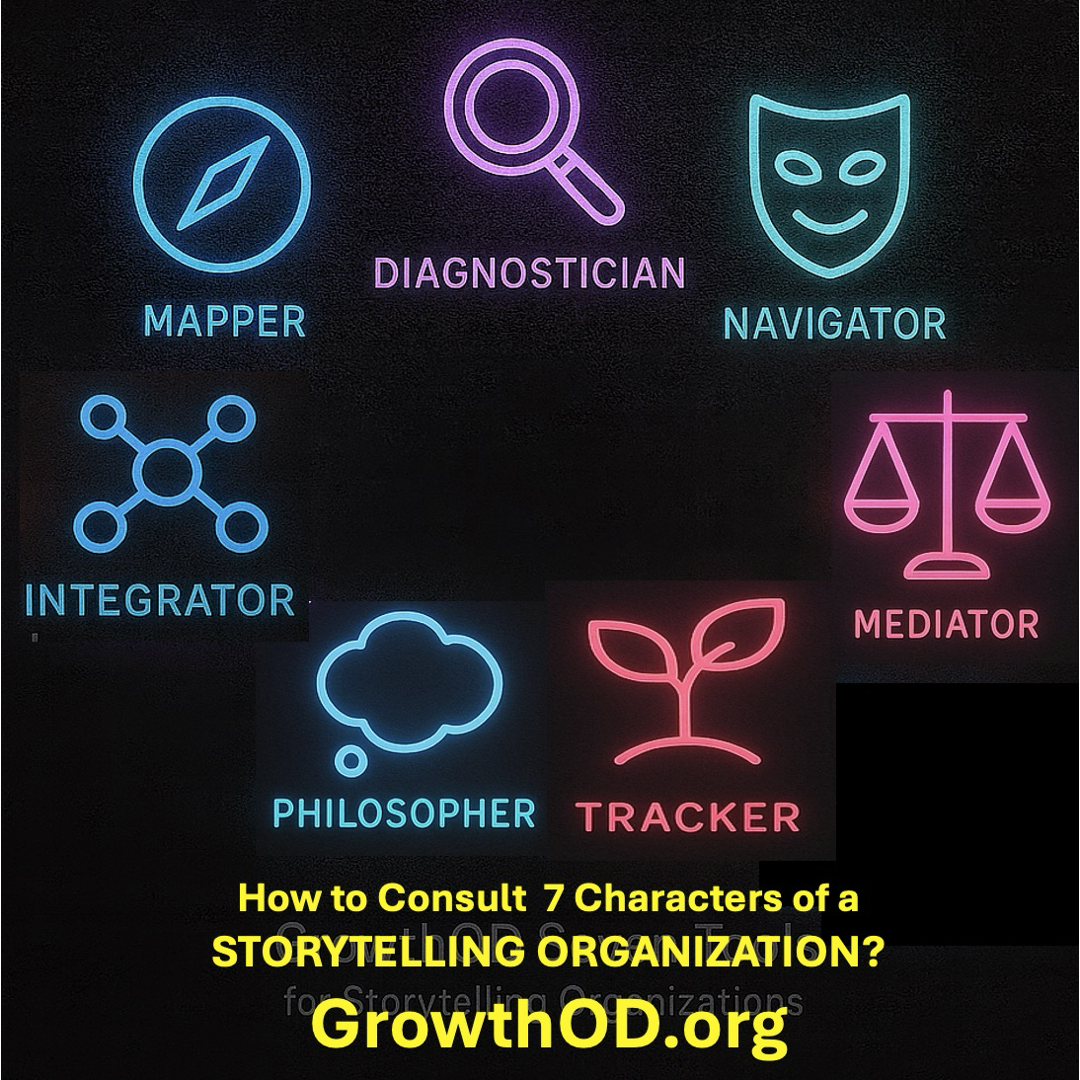
These seven tools are not a linear checklist. They are polyphonic voices in dialogue with each other, each speaking from its own embodied stance, each offering a distinct way of seeing and engaging with organizational storytelling. Following Mikhail Bakhtin's concept of polyphony, these tools don't merge into one unified method—they remain in productive tension, questioning and enriching each other.
When you work with storytelling organizations (and every organization is a storytelling organization), you need multiple voices because organizational reality itself is polyphonic. There is no single, authoritative narrative that captures "what's really happening." Instead, there are many voices, many rooms in the Tamaraland, many pre-stories morphing and competing. These tools help you work with that polyphony rather than trying to silence it into false coherence.
How to use this toolkit: Don't start with Tool 1 and proceed linearly to Tool 7. Instead, listen to your client's situation and ask which voices need to speak. Sometimes the Tracker's voice (Tool 5) needs to speak first, catching antenarratives before they harden. Other times the Mediator's voice (Tool 4) must address conflict before any other work can proceed. The tools dialogue with each other—and with you, the practitioner—in an ongoing conversation about what's needed now.
 Tool 1: The Mapper's
Character Voice
Tool 1: The Mapper's
Character VoiceStance: "Let me chart the territory. What stories exist here? Where are they flowing? What patterns emerge when we document the whole landscape?"
The Mapper speaks with systematic patience, creating the audit template that reveals what's actually being told across Tamaraland. This voice asks: "Before we intervene, what's here?"
 Tool 2: The
Diagnostician's Character Voice
Tool 2: The
Diagnostician's Character VoiceStance: "I see the errors in how this organization handles its many voices. Are they committing monologism? Finalizing people's stories prematurely? Avoiding genuine dialogue?"
The Diagnostician speaks with critical precision, using Bakhtin's framework to name what's going wrong. This voice asks: "What polyphony errors are causing dysfunction?"
 Tool 3: The
Navigator's Character Voice
Tool 3: The
Navigator's Character VoiceStance: "You cannot be in all rooms at once. Different stories are happening simultaneously in different spaces. How do we navigate this multi-sited reality?"
The Navigator speaks with spatial awareness, mapping Tamaraland's many rooms and the divergent narratives within them. This voice asks: "How do we move through complexity without pretending it's simple?"
 Tool 4: The Mediator's
Character Voice
Tool 4: The Mediator's
Character VoiceStance: "Conflict is a storytelling process with five stages. Instead of suppressing it or avoiding it, let's work through it stage by stage, restorying as we go."
The Mediator speaks with staged patience, using Pondy's framework to guide leaders through conflict's natural evolution. This voice asks: "How do we transform conflict into organizational learning?"
 Tool 5: The Tracker's
Character Voice
Tool 5: The Tracker's
Character VoiceStance: "Stories haven't formed yet. I'm tracking the pre-stories, the antenarratives, the seeds before they grow. Catch them now, before they calcify into fixed narratives."
The Tracker speaks with prospective attention, using the 7 B's to monitor fragmentary pre-stories morphing across Tamaraland. This voice asks: "What's emerging before it becomes locked in?"
 Tool 6: The
Philosopher's Character Voice
Tool 6: The
Philosopher's Character VoiceStance: "Every thought carries ethical weight in its once-occurrent event-ness. Are we thinking-and-acting together, or just performing thought without embodied responsibility?"
The Philosopher speaks with ethical urgency, connecting Pondy's enthinkment to Bakhtin's participative thinking. This voice asks: "How do we think together in ways that matter?"
 Tool 7: The Integrator's
Character Voice
Tool 7: The Integrator's
Character VoiceStance: "All the voices must come together. SEAM methodology weaves socio-economic analysis with antenarrative tracking. No tool works in isolation—everything connects."
The Integrator speaks with synthetic vision, showing how mapping, diagnosis, navigation, mediation, tracking, and philosophy form one comprehensive practice. This voice asks: "How does it all fit together?"
.
These seven voices argue with each
other. The Mapper wants comprehensive
documentation; the Tracker says "but stories are morphing
right now—we can't finalize them." The Diagnostician
identifies errors; the Mediator says "but conflict is
productive—don't pathologize it." The Navigator embraces
Tamaraland's multiplicity; the Integrator seeks connections
across fragmentation.
This tension is generative, not problematic. In Bakhtinian terms, these tools exist in dialogic relationship—they don't cancel each other out or merge into bland consensus. They remain distinct voices that challenge, complement, and enrich each other. Your job as practitioner is to orchestrate this polyphony, knowing when each voice needs to speak and how they can speak together without drowning each other out.
Start anywhere. Return often. Let the voices speak. The tools will teach you which voice your client needs to hear next.
Here's the truth: Left unorchestrated, these seven voices don't create beautiful polyphony—they create CACOPHONY. Dissonant noise. Organizational chaos. The Mapper insists on comprehensive documentation while the Tracker screams that stories are morphing right now and can't be frozen. The Diagnostician pathologizes what the Mediator knows is productive conflict. The Navigator honors multiplicity while the Integrator demands synthesis. The Philosopher calls for ethical thinking while others want practical action. The voices don't blend—they clash, contradict, and drown each other out.
This isn't a bug—it's a feature. These tools exist in less-than-ideal polyphonic relations by design. They represent genuinely different ways of seeing organizational reality, and those differences don't harmonize naturally. Used comprehensively or indiscriminately, they create confusion instead of clarity, paralysis instead of movement.
Your task as consultant/coach: bring MELODY out of this cacophony.
Not by silencing voices. Not by forcing false harmony. But by choosing strategically—which voices speak when, which parts of each tool serve THIS client's actual needs, and how to create consonance from dissonance.
Before reaching for a tool, ask yourself:
Watch out for these ways consultants create noise instead of melody:
1. The Comprehensive Applier: "Let's map the Tamaraland, diagnose polyphony errors, track antenarratives, mediate conflict, engage in enthinkment, navigate complexity, AND integrate with SEAM!" Result: Your client drowns in frameworks. You've created conceptual overload, not clarity.
2. The Wrong Tool at the Wrong Time: Using the Diagnostician's error-finding lens when the Mediator needs to legitimize productive conflict. Using the Mapper's comprehensive audit when the Tracker needs to catch emergent antenarratives before they harden. Wrong tool = amplified problems.
3. The Sequential Marcher: Starting with Tool 1 and proceeding dutifully through Tool 7 because... that's the order they're presented? No. The client's Tamaraland teaches you which melody wants to emerge. Listen to it.
4. The Forced Integrator: Rushing to Tool 7 (the Integrator) before the other voices have spoken authentically. False synthesis creates the illusion of coherence while suppressing necessary tensions.
The melody emerges when you:
Sometimes the Tracker alone creates the melody. Other times, Navigator + Mediator. Sometimes Mapper + Diagnostician, held in tension. Rarely all seven at once. The tools teach you which voices the organization needs to hear. Your job: curate the concert, not conduct the full orchestra every time.
🎵 Start anywhere. Use what's needed. Let the melody emerge. 🎵
The Mapper's Voice: "Before we intervene, let me chart the territory." Every organization with more than two rooms is a Tamaraland where you cannot be in all spaces at once. Different stories unfold simultaneously in different rooms—executive suites tell growth narratives while operations floors tell survival stories, marketing performs customer-love tales while support teams share burnout warnings. This tool maps the fragmented, competing storylines across your client's organizational landscape. You're not searching for one true story (it doesn't exist). You're documenting the polyphonic reality—the precedent stories people tell about the past, the future-directed bets they're making, the living stories unfolding right now, and the counter-stories marginalized voices keep trying to tell. Think of yourself as the systematic documentarian who reveals: "Here's what's actually being performed in each room of this Tamaraland."
Picture this: You're consulting for a mid-sized company. The CEO tells you one story about why the reorganization failed. When you talk to middle managers, you hear a completely different story. The frontline employees? They're telling yet another version. And the story customers are posting online bears almost no resemblance to any of these internal narratives.
Welcome to Tamaraland—every organization with more than two rooms. The metaphor comes from a theatrical production called Tamara, where audience members chase actors through multiple rooms in a mansion, catching fragments of simultaneous storylines but never experiencing the whole play from one vantage point. You cannot be in more than one room at a time. Meanwhile, different stories are unfolding in different spaces, and they're often contradictory, competing, and collectively constituting organizational reality.
This isn't a problem to solve—it's the nature of organizational life. Research on storytelling organizations—including detailed observations of an office supply firm and Disney—showed that organizations are storytelling systems. Stories aren't just communication tools; they constitute the performance system that shapes identity, power, change, and sensemaking. The Storytelling Audit Template helps you map this multi-sited, polyphonic reality so you can work with it rather than against it.
What is a Storytelling Organization?
Every organization is a storytelling organization. Field research in organizations has shown how employees in an office supply firm performed stories in everyday conversations—brief, fragmented, often challenged by listeners, yet constituting collective memory and shared sensemaking. These weren't polished corporate narratives with clear beginnings, middles, and ends. They were terse story performances where speakers assumed listeners would silently fill in major portions of the storyline.
Three characteristics define storytelling organizations:
1. Story Performance, Not Just Story Text
Stories in organizations aren't static texts—they're performances that vary by context, audience, and political purpose. The same "official story" about a new initiative gets performed differently in the executive suite, in department meetings, at the water cooler, and in exit interviews. When you audit organizational stories, you're tracking performances and how they shift across contexts, not just collecting written narratives.
2. Collective Storytelling Systems
Individual organizational members don't possess complete stories. Instead, they contribute fragments to a collective storytelling system where institutional memory supplements individual memories. People perform story bits that others pick up, challenge, revise, and re-perform. The organization's "story" emerges from this distributed, dynamic system, not from any single authoritative telling.
3. Tamara-land Structure
Organizational storytelling unfolds in multiple rooms simultaneously, with different audiences chasing different storylines. Studies of Disney have shown the organization operated as literal and metaphorical Tamara-land: tourists chased stories through themed lands, employees experienced divergent narratives in front-stage and back-stage spaces, and marginalized voices told darker counter-stories the official Disney legend excluded. Your client's organization works the same way—multiple stories happening at once in different spaces, and you can't catch them all from one position.
The Four Types of Stories You'll Find
When conducting a storytelling audit, you're tracking four kinds of stories that interplay in organizational Tamaraland:
1. Precedent Stories (Past-Oriented)
These are "how we got here" stories that organizational members tell to make sense of current situations by referencing past events. They include founding myths, war stories, cautionary tales, and historical precedents people invoke to justify present actions. Consulting work has shown that people performed precedent stories to support or resist change initiatives—"Remember what happened last time we tried this?"
2. Future-Directed Stories (Speculative)
These are the bets, plans, visions, and "what if" scenarios people tell about possible futures. Leaders tell aspirational stories to inspire; employees tell skeptical stories to inoculate against disappointment; consultants tell change stories to mobilize action. Future-directed stories are often antenarratives—fragmented pre-stories that haven't yet crystallized into coherent narratives.
3. Living Stories (Present-Moment)
These are the unfolding, in-process stories happening right now in organizational life. They're embodied, situated, and often unfinished. When you observe a contentious meeting, witness a customer interaction, or watch a team struggle through a problem, you're seeing living story—the raw material before it gets retrospectively narrated into tidier versions.
4. Counter-Stories (Marginalized Voices)
These are the stories official narratives exclude or suppress. They come from marginalized employees, dissatisfied customers, critics, whistleblowers, or anyone whose experience contradicts the dominant story. Analysis of Disney revealed rich counter-stories about labor exploitation, environmental destruction, and cultural imperialism beneath the surface of the happy Magic Kingdom narrative. Every organization has counter-stories—the storytelling audit makes them visible.
Why "Audit" Is the Wrong Word (But We Use It Anyway)
Traditional audits assume you're counting objective things that stay still while you count them. Organizational stories don't work that way. They're dynamic, contextual, and performative. They change based on who's listening, shift mid-telling, get challenged and revised, and morph across spaces. So when we say "storytelling audit," we don't mean a static inventory. We mean a systematic process of tracking story performances across your client's Tamaraland to reveal patterns, contradictions, silences, and possibilities.
The Political Nature of Organizational Storytelling
Stories in organizations are never neutral. They're tools of power, resistance, sensemaking, and change. Field observations have shown employees performing stories to gain political advantage, introduce change, make sense of confusing events, and challenge authority. Managers told stories that reinforced hierarchy; workers told stories that subverted it. Some stories were told openly in meetings; others were whispered in hallways. Some storytellers had authority that made their versions stick; others' versions got dismissed as "just complaining." The audit reveals not just what stories exist, but who has the power to make their stories become organizational truth.
Step 1: Map the Tamaraland
Start by identifying the physical and metaphorical rooms in your client's organization. Physical rooms might be departments, locations, hierarchical levels, customer touchpoints, or supplier interfaces. Metaphorical rooms might be formal meetings versus hallway conversations, official communications versus back-channel gossip, or digital spaces versus embodied interactions. Create a simple map showing these rooms and note: you cannot be in all rooms simultaneously, and different stories are happening in each.
Step 2: Position Story Collectors in Multiple Rooms
You need multiple observers to track simultaneous story performances. If you're a solo consultant, you'll need to move through rooms systematically over time. If you're a team, position people in different rooms. The goal is gathering story fragments from across the Tamaraland, not achieving complete coverage (which is impossible). Instruct collectors to listen for:
Step 3: Track the Four Story Types
For each room in your Tamaraland map, collect examples of precedent stories, future-directed stories, living stories, and counter-stories. Use a simple matrix:
| Room/Space | Precedent Stories | Future-Directed | Living Stories | Counter-Stories |
|---|---|---|---|---|
| Executive Suite | [Examples] | [Examples] | [Examples] | [Examples] |
| Middle Management | [Examples] | [Examples] | [Examples] | [Examples] |
| Frontline Staff | [Examples] | [Examples] | [Examples] | [Examples] |
Don't try to capture complete stories. Capture the fragments, the terse performances, the story openings that never get finished. That's the real data.
Step 4: Identify Story Patterns and Contradictions
Once you've collected fragments across the Tamaraland, analyze for patterns:
Step 5: Map Political Story Work
Stories in organizations are inherently political. People perform stories to gain advantage, resist authority, justify decisions, and shape collective memory. Track:
Step 6: Present Audit Findings as Tamaraland Map
Don't present your findings as "the organizational story"—that would deny the polyphonic reality you've discovered. Instead, present the Tamaraland map showing simultaneous, competing storylines. Use visuals showing:
Your job isn't to resolve contradictions into false coherence. Your job is making the polyphonic reality visible so the organization can work with it.
Step 7: Design Story Interventions
Once the audit reveals the storytelling landscape, you can design interventions:
A regional healthcare system hired me after a merger created massive dysfunction. The storytelling audit revealed why: Hospital A told a precedent story about being the "flagship" with superior clinical care. Hospital B told a counter-story about being the "community hospital" that actually cared about patients versus profits. In executive meetings (one room), leaders performed a future-directed story about "unified excellence." On nursing floors (other rooms), staff performed living stories about resource wars and quality decline. Patient forums (yet another room) surfaced counter-stories about worse outcomes post-merger.
The audit made visible that this wasn't one merger story—it was competing storylines in different Tamaraland rooms with no bridges between them. The intervention involved creating cross-room story sessions where Hospital A and Hospital B staff performed their precedent stories to each other, then co-created new future-directed stories that honored both legacies. Nursing staff finally got to tell their living stories of struggle to executives. Patient counter-stories were integrated into quality improvement initiatives instead of dismissed as "complaints."
Six months later, storytelling patterns had shifted. The organization hadn't achieved false unity—it still had multiple stories in different rooms. But the stories were in dialogue rather than opposition, and marginalized voices had more authority in collective sensemaking.
The Diagnostician's Voice: "I see the errors in how this organization handles its many voices." Every storytelling organization makes predictable mistakes when dealing with polyphony—the multiple, competing voices that constitute organizational reality. This tool applies Mikhail Bakhtin's framework to diagnose six critical errors: monologism (forcing all voices into one official story), finalization (prematurely closing people's stories as "finished"), theoretism (abstracting people into categories), secondhand discourse (repeating hollow corporate-speak), carnival suppression (eliminating playful challenge), and dialogue avoidance (preventing genuine conversation). You're naming what's going wrong with precision: "Your organization is committing monologism, and it's costing you innovation and engagement."
Picture this: You're in a strategy meeting at a mid-sized tech company. The VP of Product presents "our new direction." An engineer in the back raises a counter-perspective about technical feasibility. The VP smiles warmly: "That's an interesting concern, John. But we've already aligned on this with the executive team." John's voice was acknowledged—then dismissed. The meeting continues as if he hadn't spoken.
Later, you're interviewing John. He tells you this happens constantly. "They ask for our input, but they've already decided. I've learned to just nod along." Other engineers confirm the pattern. Product roadmaps get announced. Engineering concerns get "heard." Nothing changes. Turnover in engineering is 40% annually.
What you've diagnosed: monologism—one of six polyphony errors organizations commit when they mishandle the multiple voices constituting their reality. This tool teaches you to spot these errors with precision and name them clearly so your client can't pretend they're not happening.

Mikhail Bakhtin studied how Dostoevsky created novels where multiple characters spoke with equally authentic voices—no single narrator dominated, no voice was reduced to serving the author's message. He called this polyphony: genuine multi-voicedness where voices remain distinct, argue with each other, and resist merging into false harmony.
Organizations are also polyphonic systems—executives, middle managers, frontline workers, customers, suppliers all speak from different positions with different valid truths. But unlike Dostoevsky's artful polyphony, most organizations commit systematic errors that destroy authentic multi-voicedness. Bakhtin identified these errors by analyzing bad novels. We apply his framework to diagnose organizational dysfunction.
Definition: When an organization insists there's only one valid voice, one correct perspective, one official story—and all other voices must either align or stay silent.
What it looks like in practice: You're in a strategy meeting. The VP presents "our new direction." An employee raises a counter-perspective. The VP responds: "That's an interesting concern, but we've already decided." The employee's voice was acknowledged, then dismissed. Monologism isn't always loud and authoritarian—sometimes it's polite and final.
Diagnostic tells: Listen for phrases like "We're all on the same page now" or "Let's move past this debate" that signal one voice has won and all others must fall silent. Watch for the pattern of "acknowledge but dismiss"—"I appreciate your perspective, BUT we need to stay aligned with corporate messaging." That little word "but" erases everything before it.
Why it's costly: Monologism drives out your best people (who have their own voices and won't suppress them indefinitely), kills innovation (which requires challenging dominant narratives), and creates organizational brittleness (when only one story is allowed, the organization can't adapt when that story fails).
What to tell your client: "You're committing monologism. You ask for diverse input, then communicate that only one voice ultimately matters. This is why your innovation pipeline is empty and your best engineers are leaving."
Definition: When an organization treats people's stories as finished, categorizing them in ways that prevent growth, change, or surprise.
What it looks like in practice: You're interviewing Sarah, a long-time employee. She says "I'm just not a data person." Her manager nods: "Sarah's more of a people person." Sarah's story is finished—she's been categorized. But when you dig deeper, you discover Sarah taught herself Excel macros last year to solve a workflow problem. Her story isn't finished; it's been prematurely closed.
Diagnostic tells: Watch for how organizations tell finished stories about people, departments, or initiatives. "Marketing is always creative but unrealistic." "Operations is detail-oriented but resistant to change." "That team tried collaboration once and it didn't work." These are finalized narratives that prevent evolution.
Why it's costly: Finalization locks people into boxes that no longer fit (if they ever did), prevents organizational learning (if stories are finished, there's nothing new to discover), and creates self-fulfilling prophecies (people become what you've decided they already are).
What to tell your client: "You're finalizing your people's stories. You've decided who they are and closed the book on their potential. That's why talented people leave—they can't grow in a place that's already decided they're finished."
Definition: When an organization substitutes abstract categories for living voices, making people administratively manageable but humanly invisible.
What it looks like in practice: A CEO shows you a dashboard: "Our employee engagement score is 68%. Industry average is 71%. We need to improve 3 points." You ask to talk with actual employees. He looks puzzled: "But we have the data. Why would we need anecdotal information?" This is theoretism—abstracting living voices into measurable categories until the human disappears.
Diagnostic tells: Performance reviews that reduce complex people to ratings ("John is a 3 on leadership, 4 on technical skills"). Engagement surveys that replace actual conversations. Any time numbers substitute for voices, you're seeing theoretism. The organization prefers theory (abstract categories) over reality (messy human voices).
Why it's costly: Theoretism makes organizations blind to what's actually happening (dashboards show green while people are suffering), creates disconnected leadership (executives managing numbers, not leading humans), and destroys trust (people know when they've been reduced to data points).
What to tell your client: "You're committing theoretism. You've replaced human voices with survey scores and performance ratings. Your dashboard says engagement is 68%, but five people quit this month because they feel invisible. The theory is hiding the reality."
Definition: When an organization speaks in borrowed language—corporate jargon repeated without meaning, empty of authentic voice.
What it looks like in practice: Sit in any corporate meeting: "Let's circle back to align our synergies." "We need to leverage our core competencies to drive value-add solutions." This is secondhand discourse—language borrowed from elsewhere, repeated without meaning, dead on arrival. No actual human would spontaneously speak this way.
Diagnostic tells: Ask someone to explain what they just said in their own words. If they struggle or simply repeat the corporate phrase, you've found secondhand discourse. Listen for mission statements that could apply to any company. Watch for emails that sound like they were written by a committee of buzzword generators.
Why it's costly: Secondhand discourse kills meaning (nobody knows what anyone actually means), prevents real communication (can't solve problems if can't speak authentically), and signals cultural decay (when people can't speak in their own voice, something is deeply wrong).
What to tell your client: "You're using secondhand discourse. Nobody in your organization speaks in an authentic voice—it's all corporate jargon and borrowed buzzwords. This isn't communication; it's ventriloquism. And it's why nothing you say lands with employees."
Definition: When an organization eliminates spaces where hierarchy temporarily dissolves, where people can playfully challenge authority, where the official story gets mocked.
What it looks like in practice: You're observing a leadership team. Everything is serious, formal, hierarchical. Nobody jokes. Nobody playfully teases the CEO. You notice people tensing when anyone tries humor. Later, an employee tells you: "We used to have fun here. Now everything feels dangerous."
Diagnostic tells: Notice what can't be joked about. Can employees playfully tease leaders without fear? Is there humor in meetings, or only nervous laughter at approved jokes? Can someone make a satirical comment about corporate initiatives without being marked as "not a team player"? Healthy polyphony needs carnival—moments when the normal order gets questioned through play.
Why it's costly: Carnival suppression makes organizations brittle (no safety valve for pressure), kills creativity (innovation requires playing with ideas), and breeds resentment (when you can't laugh at authority, you start to hate it).
What to tell your client: "You've suppressed carnival. Your organization is humorless, hierarchical, and tense. People can't playfully challenge authority, so they're either silently resentful or actively planning their exit. You need spaces where the official story can be mocked without consequence."
Definition: When an organization stages the appearance of multi-voiced conversation while ensuring genuine dialogue happens nowhere official.
What it looks like in practice: You observe a leadership team meeting. Discussion seems productive. Afterward, you hear clusters of people in hallways having the REAL conversation: "We can't actually say what we think in there." The meeting was performance. Dialogue was avoided.
Diagnostic tells: Meetings that feel performative, conversations that never reach conflict, decisions that everyone "agrees" to but nobody commits to, and the constant refrain "Let's take this offline." When the real conversation happens after the official meeting ends, you're witnessing dialogue avoidance.
Why it's costly: Dialogue avoidance means decisions get made without genuine thinking-together (so they fail in implementation), creates cynicism (people stop believing anything real happens in official spaces), and wastes massive time (the same conversation happens over and over in hallways because it never really happened in the meeting).
What to tell your client: "You're avoiding dialogue. Your official meetings are theater—the real conversations happen in hallways after. This is why your decisions never stick and your implementation always fails. You're not actually talking to each other where it counts."
Step 1: Observe Across Multiple Settings
Don't rely on interviews alone. Sit in meetings. Read emails. Listen to hallway conversations. Walk the floor. Eat lunch in the cafeteria. You're looking for patterns of how voices get handled—welcomed, dismissed, categorized, deadened, mocked, or avoided.
Step 2: Create an Error Matrix
For each polyphony error, document specific examples:
Step 3: Name the Errors Explicitly
Don't soften your diagnosis. Your client needs to hear: "You're committing monologism. Here's what it looks like. Here's what it's costing you." Use Bakhtin's terminology—it gives you authority and precision. The errors have names. Use them.
Step 4: Connect Errors to Business Impact
For each error you diagnose, show the cost: turnover rates, innovation pipeline failures, implementation breakdowns, customer complaints. Polyphony errors aren't theoretical—they have measurable economic shadows (use Tool 7 to quantify hidden costs if needed).
Step 5: Prioritize Which Errors to Address First
Most organizations commit multiple polyphony errors simultaneously. You can't fix everything at once. Help your client see which error is creating the most damage and start there.
The Navigator's Voice: "You cannot be in all rooms at once. Different stories are happening simultaneously in different spaces." Every organization with more than two rooms is a Tamaraland—a theatrical metaphor where audiences chase actors through a mansion, catching fragments of simultaneous storylines but never experiencing the whole play from one position. Your client's organization works the same way: executives tell growth narratives while operations tells survival stories, marketing performs customer-love tales while support teams share burnout warnings. This tool teaches you to navigate multi-sited organizational reality skillfully, honoring multiplicity without trying to force false unity. You're helping clients see: "How do we move through complexity without pretending it's simple?"
Picture this: You're consulting for a company six months post-merger. You start in the Executive Room. The CEO tells you: "Integration is going smoothly. We're one company now. Culture alignment is excellent." You take notes, nodding.
Next, you visit the Sales Room. A different story: "We still don't know which CRM system we're supposed to use. I have accounts in both databases. Customers are confused about who to call. Nobody will make a decision."
Then the Engineering Room: "Their code standards are amateur—we can't merge the codebases. But leadership keeps pushing for 'one unified platform.' It's technically impossible with the time and resources they're giving us."
Finally, the Customer Service Room: "Customers are furious. They get transferred between 'old company' and 'new company' reps. We're apologizing constantly for problems we can't explain. Morale is terrible."
Four rooms. Four completely different stories about the same organizational reality. This is Tamaraland—and you, the consultant, cannot be in all rooms at once. You experience fragments, contradictions, and competing truths. Welcome to organizational reality as it actually exists.
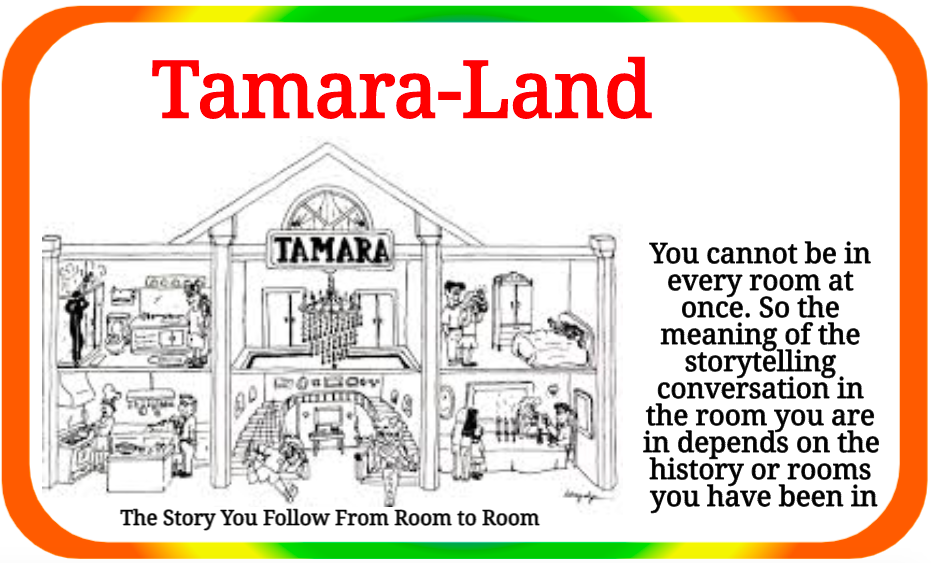
The metaphor comes from a 1980s theatrical production called Tamara, staged in a Los Angeles mansion. Multiple storylines unfolded simultaneously in different rooms. Audience members chose which actors to follow, chasing them from room to room. You caught fragments—never the whole story. Different audience members experienced completely different versions of the play based on which rooms they chose.
Organizations work exactly this way. Leadership experiences one organizational reality. Frontline employees experience another. Customers experience yet another. Marketing sees opportunities; operations sees constraints. Remote workers inhabit different spaces than office workers. Each room tells its own story, and those stories often contradict each other.
This isn't a problem to solve—it's the nature of organizational life. Tamaraland navigation means working with multi-sited reality rather than trying to force it into false unity. You're not searching for one true story (it doesn't exist). You're helping your client navigate multiplicity skillfully.
Consultants often privilege one room's perspective as the "real" story. Usually the executive room—because that's who hired you and who has authority. But when you treat the executive narrative as truth and all other rooms as "resistance" or "misunderstanding," you've become an agent of monologism (Tool 2's first error).
Better approach: Treat all rooms as offering legitimate perspectives on organizational reality. The executive story is one valid view. So is the frontline story. So is the customer story. They don't have to agree—they're seeing from different vantage points.
Many consultants see Tamaraland's multiplicity as a communication problem: "They're not aligned! We need clearer messaging!" So they craft one official narrative and push it through all rooms. This is like trying to make all audience members at Tamara experience the same play—it defeats the point.
Better approach: Help the organization function as Tamaraland. Create bridges between rooms so stories can dialogue, but don't force false unity. The goal isn't one story—it's stories that can speak to each other across difference.
You can't. You're bound by time and space like everyone else. You experience fragments. Consultants who claim comprehensive understanding are either lying or deluded. Part of Tamaraland navigation is acknowledging: "I can only be in one room at a time. I'm catching fragments, like everyone else."
Better approach: Be transparent about your partiality. Tell your client: "I've visited four rooms. There are probably twelve more I haven't seen. Here's what I'm hearing in the rooms I can access." This honesty builds trust and models the humility organizations need.
The Situation: Leadership launched an "innovation initiative" with great fanfare. You visit different rooms:
Typical consultant response: "There's a communication problem! Leadership needs to explain the innovation initiative better!" This assumes the Innovation Team room has the true story and other rooms just don't understand yet.
Tamaraland navigation response: All four rooms are right. The Innovation Team genuinely feels empowered. Department heads genuinely experience overload. Frontline workers genuinely have initiative fatigue. Customers genuinely haven't seen change. These aren't contradictions—they're different valid perspectives from different organizational positions.
Your navigation strategy:
The Situation: Post-pandemic, your client is fighting over return-to-office policy. Each room has a completely different story:
Typical consultant response: Recommend a hybrid policy as "compromise." But compromise between incompatible needs doesn't actually serve anyone—it just distributes dissatisfaction evenly.
Tamaraland navigation response: This isn't a problem with one solution. It's multiple legitimate needs in tension. Executives genuinely observe collaboration problems. Parents genuinely need flexibility. Introverts genuinely thrive remotely. All true simultaneously.
Your navigation strategy:
The Situation: Leadership spent months crafting a new strategy. They rolled it out with beautiful presentations. Three months later, nothing has changed. You investigate:
Typical consultant response: "This is a change management problem. People are resistant. They need more training and communication."
Tamaraland navigation response: The strategy isn't failing because people don't understand it. It's failing because it was created in one room (executive) and imposed on all other rooms without considering how it looks from their vantage points. The strategy might be brilliant from the executive room's position—and simultaneously impossible from operations' position. Both true.
Your navigation strategy:
Step 1: Map the Rooms Explicitly
Don't assume you know all the rooms. Ask your client: "Where are the distinct spaces in this organization? Where do different stories get told?" Physical rooms (departments, locations, levels), metaphorical rooms (formal meetings vs. hallways, Slack vs. email, office vs. remote), and identity-based rooms (parents, early-career, technical vs. business).
Create a literal map if helpful. Show: "Here are the seven rooms I've identified. You cannot be in all seven simultaneously. Different realities are unfolding in each."
Step 2: Visit Multiple Rooms Systematically
Don't stay in the executive room (or whichever room hired you). Systematically visit diverse rooms. Interview people across levels, departments, locations. Observe meetings in different spaces. Read communications in different channels. You're tracking how the same organizational reality looks radically different from different positions.
Step 3: Document Stories by Room
For each major organizational issue, collect the different rooms' stories:
Don't try to reconcile contradictions. Document them faithfully. Your job is showing multiplicity, not resolving it artificially.
Step 4: Make Tamaraland Visible to Your Client
Most organizations don't consciously recognize they're Tamaralands. They think there's one organizational reality that some people understand correctly and others misunderstand. Show them: "No. There are multiple simultaneous realities unfolding in different rooms. Here's what the merger looks like from four different positions. They don't agree. They're not supposed to."
Step 5: Build Bridges, Not Unity
Instead of trying to create one story everyone accepts, build bridges between rooms:
Step 6: Acknowledge Your Own Partiality
You're also experiencing Tamaraland partially. You have access to some rooms, not others. Your presence changes what gets said. You can only be in one place at a time. Model the humility you want the organization to develop: "I'm catching fragments, like everyone else. Here's what I see from where I stand."
Use this tool when:
The Mediator's Voice: "Conflict is a storytelling process with five predictable stages—let's work through it together, not around it." When leadership teams collide, they're not just disagreeing about strategy or resources—they're caught in conflict as a narrative event unfolding through Louis Pondy's five stages: latent conflict (conditions ripe for clash), perceived conflict (sensing tension), felt conflict (emotional activation), manifest conflict (open warfare), and conflict aftermath (what remains after the battle). Most consultants try to suppress or avoid conflict. This tool helps you facilitate restorying—guiding leaders through conflict's natural progression so they transform rather than repeat it. You're the patient mediator who says: "We're in Stage 3—let's acknowledge the emotions before we jump to solutions, or this will just cycle back." Conflict becomes organizational learning when you work with its stages, not against them.
Format: Worksheet + coaching prompts
Purpose: Address leadership storytelling battles
(boardroom conflicts, CEO-vs-investor narratives)
Components:
.
Leadership
Conflict is analyzed in Louis Pondy’s model
Pondy’s model of
organizational conflict provides a valuable framework for
understanding and addressing leadership conflicts in
organizations. The model is structured around five distinct
stages, each highlighting a different dimension of how
conflicts emerge, develop, and resolve within groups,
including leadership teams. In his seminal 1967 article, Pondy
also identifies three types of organizational systems where
conflict dynamics play out.

Figure
1: The Conflict Model is from Boje,
D. M., & Saylors, R. (2023). The management
thought of Louis R. Pondy: Reclaiming the enthinkment
path. Routledge.
PERVIEW coaching
offers a robust narrative and energy-based method for
transforming leadership conflict, integrating embodied
practices and storytelling into each stage of the Pondy
conflict model. Applying all seven PERVIEW steps to Pondy's
(1967) framework illuminates how narrative coaching can
strategically guide leaders through complex organizational
disputes.
Integrating
PERVIEW Coaching with the Pondy Conflict Model
Pondy's conflict
model organizes conflict into five stages: latent, perceived,
felt, manifest, and aftermath, with each stage requiring
unique interventions and perspectives for lasting resolution
(Pondy, 1967). The seven steps of the PERVIEW
method—Processes, Embodied, Restorying, Vibrations, Internal,
Energy, Waves—expand upon each stage by facilitating narrative
transformation, energetic rebalancing, and restorying for
positive leadership outcomes (Boje & Rosile, 2025).
Step 1:
Characterize Dysfunction and Possibility (Latent Conflict)
In the latent stage
of Pondy's model, underlying conditions create the potential
for conflict, even if not yet recognized (Pondy, 1967).
PERVIEW coaching invites leaders to surface unspoken stories,
identify contradictions, and assess vibrational energy
patterns associated with resource scarcity, autonomy
challenges, and divergent goals. Coach prompts such as "What
unspoken stories are present about work conditions?" activate
awareness and lay the foundation for narrative transformation
(Boje & Rosile, 2025).
Step 2:
Externalize Problems (Perceived Conflict)
As leaders become
aware of looming conflict, PERVIEW coaching encourages
externalization—moving the problem-laden narrative outside the
person into systems and patterns. By naming character
archetypes or "systemic forces," leaders see that dysfunction
emerges from complex organizational systems, not individual
flaws. This reframing clarifies areas such as training gaps or
policy mismanagement, aligning with Pondy's emphasis on
perceived threats to the status quo (Boje & Rosile, 2025;
Pondy, 1967).
Step 3:
Sympathize—Emotional Truth and Payoff (Felt Conflict)
Felt conflict is
marked by emotional intensity, tension, and personalization of
conflict (Pondy, 1967). In PERVIEW, the coach facilitates
empathic dialogue to surface emotional realities—for example,
how repeated communication fatigue or ignored contributions
have shaped morale. This step is essential for restoring
safety, validating embodied responses, and guiding leaders
toward honest self-inquiry (Flora et al., 2016; Boje &
Rosile, 2025).
Step 4:
Revise—Testing New Narratives (Manifest Conflict)
During manifest
conflict, open behaviors—verbal disagreements,
opposition—surface. The PERVIEW coach helps leaders co-create
revised narratives, envision more humane practices, and
experiment with new behaviors and rituals. By testing change
(e.g., new meeting protocols), leaders move past stuck
storylines and actualize preferred futures, directly
addressing behaviors and structures visible in manifest
conflict (Boje & Rosile, 2018; Cast et al., 2013).
Step 5:
Strategize—Planning Change and Exceptions
Post-revision,
coaching shifts to action planning by highlighting "little wow
moments"—exceptions that reflect desired practices. Leaders
strategically implement new protocols and rhythms (e.g., daily
huddles for coordination), reinforcing effective change and
embedding narrative adjustments into organizational routines
(Boje & Rosile, 2025).
Step 6:
Rehistorize—Embedding Stories in Time (Aftermath)
In the aftermath
stage, Pondy emphasizes lingering effects and learning after
conflict resolution (Pondy, 1967). PERVIEW's rehistorizing
step guides leaders to weave new stories into broader
organizational timelines—connecting past, present, and future
to transform legacy beliefs. This step ensures that healing is
sustainable, and that updated narratives inform ongoing
practices (Rosile & Boje, 2002; Rosile et al., 1998).
Step 7: Publicize
and Anchor—Shared Identity
Finally, leaders
share the new story with stakeholders, solidifying identity
changes through communication rituals—voice, posture, symbols.
The closing ceremony involving breathwork and somatic
anchoring marks the transition from old to new meanings,
ratifying transformation (Boje & Rosile, 2025).
Analysis of the
Disney/Kimmel Leadership Conflict Using the PERVIEW Method and
Pondy’s Conflict ModelSession Start
Step 1: Characterize
Current Dysfunctions and the Organization at Its Best (Latent
Conflict)
Step 2: Externalize
Move the 'Problem Saturated Account' (Perceived Conflict)
Step 3: Sympathize
With the Payoff for Keeping Habits (Felt Conflict)
Step 4: Revise What
Are the Consequences? Test Revised Narratives (Manifest
Conflict)
Step 5: Strategize
List ‘Little Wow Moments’ and Turn Into Plans
Step 6:
Rehistoricize Embed the New Story Into a Timeline (Aftermath)
Step 7: Publicize
Who Can You Tell? Share the New Story
@FreeKimmel
, 2025) amplifies
this (Boje, 2025).
Closing Ceremony
· Ritual: Box breathing (4-4-4-4), state
the new leadership story aloud, clap three times, ratify
with “That was a big one, wasn’t it?” (Boje & Rosile,
2025).
The Tracker's Voice: "Stories haven't formed yet—I'm catching the seeds before they grow." Every polished narrative your client tells started as antenarrative—fragmented hunches, half-formed ideas, competing speculations swirling across the organization. These pre-stories are morphing right now in the restorying process, and you cannot make narratives without them. This tool tracks seven antenarrative processes (the "7 B's") before they calcify into fixed stories: BENEATH (hidden values and assumptions), BEFORE (multiple histories shaping present sensemaking), BETS (speculative wagers on possible futures), BEING (present-moment action and creation), BECOMING (transformation and evolution underway), BETWEEN (relationships across Tamaraland's rooms), and BEYOND (intuitive reflection transcending polarities). You're working upstream—catching organizational pre-stories while they're still plastic, before premature narrative closure locks them into forms that may not serve your client's future.
Every polished story you tell in your organization started somewhere else—as fragments, hunches, half-formed ideas, and possibilities swirling in the minds of your people. These aren't stories yet. They're what David Boje calls antenarratives—the pre-story seeds that haven't crystallized into narratives with clear beginnings, middles, and ends. Think of them as the raw material of organizational storytelling, the unplotted speculation that precedes every coherent narrative your company eventually tells.
Here's why this matters to you as a consultant or coach: You cannot make a narrative without antenarratives. More importantly, antenarratives are always renewing and morphing in what Boje calls the "restorying process." While traditional consultants focus on the finished stories organizations tell themselves, antenarrative work helps you track and shape the pre-stories before they harden into fixed narratives that may not serve your client well. This is upstream work—catching the story before it calcifies.
The challenge? Your clients live in Tamaraland. Every organization with more than two rooms is a Tamaraland, and you cannot be in more than one room at a time. Different pre-stories are emerging simultaneously in different spaces, and they're often contradictory. The 7 B's framework gives you a systematic way to track these fragmentary antenarratives across your client's organizational landscape.
Boje developed the concept of antenarrative in his 2001 book Narrative Methods, initially focusing on two dimensions: Before (ante meaning "prior to") and Bets (ante meaning "wager"). Over two decades of research and practice, he identified seven distinct processes that constitute how pre-stories emerge and eventually become narratives. These aren't sequential stages—they're simultaneous, interweaving processes happening throughout your client's organization.
What exactly is an antenarrative? Boje defines it as "the fragmented, non-linear, incoherent, collective, unplotted, and pre-narrative speculation, a bet, a proper narrative can be constituted" (2001: 1). It's the messy, unfinished, multi-vocal storytelling that happens before someone imposes plot, coherence, and closure. It's prospective rather than retrospective—looking forward to possible futures rather than backward at settled pasts.
The seven processes organize into what Boje calls the "Four Hearts" (vertical/spatial) and three temporal processes that connect them:
1. BENEATH – The Heart of Abstraction
This is the foundation layer—the values, assumptions, motivations, and unconscious drivers beneath the surface story. In consulting terms, it's what you're hunting for when you ask "What's really going on here?" BENEATH work means going below the official narrative to uncover the fore-conceptions (preconceived notions) that shape how people interpret events. It's about uncovering hidden forces: the unspoken values, the tacit assumptions, the "that's just how we do things" that nobody questions. When a leadership team tells you "we value innovation" but punishes every failed experiment, you're seeing the gap between stated narrative and BENEATH reality.
Practitioner Question: What assumptions and values are driving behavior beneath the surface story your client tells?
2. BEFORE – The Heart of Historical Context
BEFORE captures the multiple histories and past experiences that shape current sensemaking. This isn't just "company history"—it's the layered, often contradictory stories about what happened before. In Tamaraland terms, different rooms have different BEFORE stories. The sales team's version of "what happened in Q3" differs from engineering's version, which differs from the CEO's version. BEFORE work means acknowledging that your client's organization has multiple pasts, not one tidy history. These various pasts are "already there in advance" (what Boje calls "fore-having"), shaping how people make sense of present situations.
Practitioner Question: What different histories are people carrying forward, and how do these shape their current interpretations?
3. BETS – The Heart of Prospective Sensemaking
BETS represents the wagers people make about possible futures—the "what if" scenarios, the risks they're willing to take, the prospective sensemaking before outcomes are known. Every strategic initiative is a BET, but so is every manager's decision about which project to prioritize, every employee's choice about which skills to develop. BETS work tracks the fragmented speculation about future possibilities floating through your client's organization. What are people betting will happen? What futures are they trying to bring into being through their actions? What dangerous or generative bets are in play?
Practitioner Question: What bets on the future are different groups making, and which bets are in conflict?
4. BEYOND – The Heart of Intuitive Reflection
BEYOND is the most elusive process—what Boje calls "openness to mystery" and "fore-grasping" (intuitive knowing that's already there in advance). It's the reflective capacity to transcend dualities and polarities that trap organizations in either/or thinking. BEYOND work means helping clients access what Indigenous Ways of Knowing call spiritual ecology—the intuitive sense of value that goes past facts, opinions, and intellectual debate. When your client is stuck in data wars ("our numbers say X" vs "our numbers say Y"), BEYOND work creates space for reflection on what matters and why. It's meditative, embodied, and often the hardest work because it requires unlearning fixed positions.
Practitioner Question: How can we create space for reflection that transcends the polarities trapping this team?
5. BEING – The Center Point of Present Action
BEING is where the four hearts converge—it's the changing present moment where people actively create and shape their pre-stories through action. This is about spacetimemattering (a term from Karen Barad that Boje adopts): the way space, time, and matter are inseparable in how organizations exist. BEING isn't static; it's the ongoing event-ness of organizational life. In practical terms, BEING work means tracking what's happening right now, in real-time, as people enact their pre-stories through decisions, conversations, and behaviors. It's the living story unfolding before it becomes a retrospective narrative.
Practitioner Question: What is actually happening right now in the present moment as people shape their story?
6. BECOMING – The Transformation Process
BECOMING captures the transformation, growth, and evolution underway—the process of restorying itself. This is where antenarratives morph and renew. Old pre-stories transform into new ones; fragments coalesce into different configurations. BECOMING work focuses on helping your client's "little wow moments" (small insights and shifts) grow into new stories. It's about facilitation of emergent change rather than imposed change. You're working with the natural process of story evolution, not fighting it.
Practitioner Question: What transformations are underway, and how can we help emerging stories develop?
7. BETWEEN – The Tamaraland Connector
BETWEEN is the relational space—the connections, relationships, and networks across the organizational Tamaraland. This is where Boje's work gets particularly sophisticated: BETWEEN work means facilitating dialogue across what he calls the "Four Who's" (Ego-Who, Corporate-Who, Community-Who, and Eco-Who). These represent different levels of consciousness and concern. BETWEEN work is staging conversations where people in different "rooms" (physically or metaphorically) can connect their divergent pre-stories. It's ensemble storytelling rather than solo performance.
Practitioner Question: What connections need to be made between different rooms/groups/consciousnesses in the client's Tamaraland?
Step 1: Map the Tamaraland
Start by identifying the different "rooms" in your client's organization. These might be departments, locations, hierarchical levels, or functional groups. Remember: you cannot be in more than one room at a time, and neither can your client's people. Different pre-stories are emerging in each room. Create a simple map showing these spaces and the people in them.
Step 2: Listen for Antenarrative Fragments
Antenarratives are fragmented, non-linear, and unplotted. Train yourself to hear them differently than finished narratives. Listen for:
Don't try to reconcile the fragments into one coherent narrative yet. Your job is to collect the raw, unfinished material.
Step 3: Sort by the 7 B's
For each antenarrative fragment you capture, ask which process it belongs to:
Create a simple matrix with the 7 B's across the top and your Tamaraland rooms down the side. Drop fragments into the appropriate cells. Patterns will emerge showing where certain processes dominate and where they're absent.
Step 4: Identify Conflicting Bets and Misaligned BENEATH
Look for places where different rooms are making contradictory BETS about the future, or where BENEATH assumptions conflict. These are your intervention points. For example: if the executive suite is betting on aggressive growth while operations is betting on stability, you've found a critical misalignment. If one department's BENEATH assumptions are "customers are demanding" while another's are "customers are partners," you've found a values clash driving surface conflicts.
Step 5: Facilitate BETWEEN Conversations
Use the 7 B's framework to structure cross-room dialogue. Bring people together and have them share their antenarrative fragments in each category. The goal isn't to force consensus but to create awareness of the multiple pre-stories in play. Ask questions like:
Step 6: Track the Restorying Process
Remember: antenarratives are always morphing and renewing. This isn't one-time mapping. Set up a regular rhythm (monthly or quarterly) to re-track the 7 B's across your client's Tamaraland. Watch how pre-stories evolve, which bets get abandoned or doubled down on, how BENEATH assumptions shift, and where new BETWEEN connections form. The tracker becomes a living document showing the organization's antenarrative landscape over time.
Step 7: Work BEYOND When Stuck
When your client hits polarized deadlock—when data battles and dueling narratives create paralysis—shift to BEYOND work. Create space for intuitive reflection. This might mean walking in nature, sandtray work, embodied practices, or simply asking "What do we value here, really?" BEYOND work helps organizations transcend the either/or traps that BENEATH analysis alone cannot resolve.
A software company acquired a smaller competitor and hired a consultant to help with integration. Traditional change management focused on process alignment and culture fit. The antenarrative approach revealed something different. Using the 7 B's tracker across the merged Tamaraland showed: BENEATH assumptions conflicted fundamentally—the acquirer assumed "we're saving them" while the acquired assumed "we're being colonized." BEFORE histories were incompatible—each had origin myths about being scrappy underdogs. BETS diverged—acquirer was betting on synergies through standardization; acquired was betting on autonomy driving innovation. BETWEEN connections were nearly absent—the two groups occupied different buildings and rarely spoke.
The consultant facilitated cross-company conversations organized by the 7 B's. Instead of asking "how do we integrate cultures," they asked "what are the BENEATH values each side brings?" and "what BETS might we make together that neither could make alone?" The restorying work didn't eliminate all conflict, but it shifted from a narrative of conquest to a narrative of hybrid emergence. Eighteen months later, the combined company had developed genuinely new products neither predecessor could have built—because they learned to work with conflicting antenarratives rather than forcing premature narrative closure.
The Philosopher's Voice: "Every thought carries ethical weight in its once-occurrent event-ness. Are we thinking together, or just performing thought?" This tool bridges Louis Pondy's concept of "enthinkment" (organizational thinking as collective practice) with Mikhail Bakhtin's participative ethics (every moment of consciousness is ethically answerable). Most organizations assume thinking is individual cognition—leaders think, then communicate; experts think, then advise. This tool challenges that assumption: real thinking-about-what-matters happens participatively, through dialogue, in relationships. You're helping clients shift from "I decide, you implement" to "We think together about what this organization needs to become." This isn't soft philosophy—it's practical intervention that transforms how organizations make decisions, solve problems, and create meaning together.
Picture this: You're consulting for a retail company facing digital disruption. The CEO spent three months with consultants developing a comprehensive digital transformation strategy. It's brilliant—well-researched, data-driven, aligned with industry trends. He presents it to his leadership team in a slick PowerPoint deck.
The room nods politely. Questions focus on logistics: timelines, budgets, responsibilities. Nobody challenges the core premises. The meeting ends with apparent agreement. Implementation begins.
Six months later, nothing has really changed. Digital initiatives are underfunded, understaffed, and quietly de-prioritized. The strategy document gathers digital dust in a SharePoint folder. You interview the leadership team. Their responses reveal the problem:
The problem isn't the strategy's content. It's that the thinking happened in the CEO's head (with expensive consultant support). The leadership team received the conclusions but didn't participate in the thinking itself. They never owned it because they never co-created it. This is the difference between individual cognition and enthinkment—thinking alone versus thinking together.

Louis Pondy, studying organizational decision-making, noticed something curious: the most effective organizational changes didn't come from brilliant individual leaders deciding what to do. They emerged from groups thinking together about problems until collective understanding formed. He called this process "enthinkment"—organizational thinking as participative practice rather than individual cognition.
Traditional management assumes:
Enthinkment challenges this:
Mikhail Bakhtin took this further. He argued that every moment of consciousness carries ethical weight because it's "once-occurrent"—it happens exactly once, with these people, in this situation, and will never be repeated. Every thinking moment creates reality rather than just describing it.
When a CEO thinks alone about strategy, he's thinking about the organization from outside it. When a team thinks together about strategy, they're thinking as the organization—participatively creating their collective understanding of what they're becoming.
This has ethical implications:
Scenario: A manufacturing company faces competitive pressure from overseas producers with lower labor costs. The CEO doesn't know the answer. Genuinely doesn't know. He convenes a cross-functional team: operations, finance, sales, engineering, HR, frontline supervisors. He says:
"We're facing an existential challenge. I don't have the answer. I need to think about this WITH you, not FOR you. Our usual competitive advantages aren't working anymore. What do we do?"
The group meets weekly for two months. Not to "give input" to the CEO's predetermined direction. To actually think together about the problem. Ideas emerge in dialogue:
The thinking emerges in the conversation itself. Not before (in the CEO's head) or after (in implementation). The group genuinely doesn't know where they'll end up when they start. The CEO's thinking changes as he hears others. Others' thinking changes as they hear each other. Collective understanding forms.
When they eventually decide on "agile manufacturing focused on mass customization," nobody needs convincing. They already own the decision—they participated in creating the understanding that led to it. Implementation becomes natural because the thinking was collective from the start.
Enthinkment indicators:
Same scenario, different approach: The CEO already knows what he wants: shift to mass customization. He's decided. But he's been told he should "get buy-in" and "involve people in decision-making." So he stages a series of "listening sessions."
He presents his direction (framed as a question: "What do you think about focusing on mass customization?"). People offer thoughts. He nods enthusiastically. Takes notes. Thanks everyone for their valuable input. Then implements exactly what he planned before the meetings started.
The thinking happened elsewhere—in his head, in consultant reports, in executive retreats. The "listening sessions" were theater. He was managing the appearance of participation, not actually thinking collectively.
People sense this immediately. They participate because it's expected, but they know their actual thinking doesn't matter. The decision was made before they entered the room. This isn't enthinkment—it's performative participation. And it's ethically problematic (more on that below).
Pseudo-participation indicators:
Why is pseudo-participation ethically problematic? Bakhtin's concept of "once-occurrent event-ness" helps us see: this moment, THIS conversation, with THESE people, happening right NOW, will never occur again exactly this way. Every thinking moment is unique and unrepeatable.
When we stage pseudo-participation, we're treating that unique moment as administrative theater. We're pretending to think together while ensuring the real thinking stays elsewhere. This is ethically problematic because:
Real enthinkment honors the ethical weight of thinking-together: these voices matter, this moment matters, our collective understanding is being created right now through this dialogue. Pseudo-participation treats thinking as administrative procedure: check the box, manage appearances, keep control centralized.
Step 1: Create Real Uncertainty
Leaders must genuinely not know the answer. Not "I know but I'm pretending I don't." Actually not knowing. If the leader has already decided, don't stage participation—just communicate the decision honestly and own it. Fake uncertainty is worse than no participation.
Test: Can the leader articulate what would change their mind? If not, the uncertainty isn't real.
Step 2: Invite Diverse Voices from Across Tamaraland
Enthinkment requires genuine polyphony (Tool 2). Don't just convene the usual suspects or people who think like leadership. Bring unexpected voices—different rooms (Tool 3), different perspectives, different experiences. The thinking emerges from dialogue across difference.
Test: Would the conversation be fundamentally different if different people were in the room? If not, you don't have real diversity of thinking.
Step 3: Slow Down—Enthinkment Can't Be Rushed
Collective understanding formation takes time. You can't enthink in 60-minute meetings. Plan for multiple sessions. Let ideas sit overnight. Give people time to wrestle with complexity. Resist the pressure to reach conclusions quickly.
Test: Are people leaving sessions with different thinking than they brought? If everyone's thinking is the same going out as coming in, genuine enthinkment hasn't happened.
Step 4: Protect Dialogue Space
Don't let habitual speakers dominate. Don't let hierarchy silence certain voices. Don't allow conversation to default to comfortable patterns. Your job as facilitator: ensure genuine dialogue where all voices can influence collective thinking.
Techniques:
Step 5: Stay with Difficulty—Don't Rush to Resolution
Real thinking gets uncomfortable. Contradictions emerge. People disagree. The group doesn't know where they're going. This is good. This is enthinkment happening. Don't rescue them by providing answers or steering toward predetermined conclusions.
Test: Is the group wrestling with genuine difficulty, or performing agreement? Real enthinkment involves productive struggle.
Step 6: Notice When Collective Understanding Emerges
You'll feel it in the room. The energy shifts. Multiple people start building on each other's ideas fluidly. Someone says something and others respond "Yes, and..." rather than "Yes, but..." The thinking is becoming genuinely collective.
These moments are precious—they're what makes enthinkment worth the investment of time and difficulty. Name them when they happen: "Notice what just occurred—we thought our way to understanding together."
Step 7: Acknowledge the Once-Occurrent Event-Ness
At the end, help the group recognize what happened: "This conversation, with these people, will never occur again exactly this way. We created understanding together that none of us had individually. That's significant." This honors the ethical weight of thinking-together.
Obstacle 1: "We don't have time for all this thinking-together"
Response: "You'll spend the time either in enthinkment up front, or in implementation struggles later when people don't own the thinking. Which is actually faster?"
Obstacle 2: "Leadership needs to lead—they can't wait for consensus"
Response: "Enthinkment isn't consensus or democracy. Leaders can still lead. But leading through collective thinking creates ownership that individual decisions can't match."
Obstacle 3: "What if the group thinks their way to the wrong answer?"
Response: "Define 'wrong.' If collective understanding forms around a direction, implementation becomes natural. If the leader imposes the 'right' answer that the group doesn't own, implementation fails. Which is more wrong?"
Obstacle 4: "People don't really want to participate—they want leaders to decide"
Response: "People have learned that participation is often theater. They're protecting themselves from fake engagement. Genuine enthinkment is different—they'll recognize it and engage."
Use this tool when:
Don't use enthinkment when:
The Integrator's Voice: "Show me the money—and the stories behind it." While Tools 1-6 give you powerful ways to work with organizational narratives, SEAM (Socio-Economic Approach to Management) reveals the economic reality beneath those stories. Every polyphony error, every silenced counter-narrative, every untracked antenarrative carries a price tag your client's accountants can't see. SEAM makes those hidden costs visible—averaging $20,000-$80,000 per employee annually—and transforms storytelling insight into measurable performance improvement. This isn't about choosing between narrative work OR economic analysis. It's about showing how they're inseparable. The Integrator asks: "How do all these tools create real, measurable organizational change together?"
Picture this: You've just completed a brilliant storytelling audit (Tool 1) for a 200-employee company. You've mapped their Tamaraland, diagnosed polyphony errors (Tool 2), and tracked antenarratives (Tool 5). The CEO nods appreciatively at your insights about narrative dysfunction. Then asks: "But what's this costing us? And how does fixing it impact our bottom line?"
Most consultants stumble here. They know the storytelling problems are real. They sense the organizational pain. But they can't connect narrative dysfunction to financial performance in ways that executives trust and act upon.
Enter SEAM. Developed by Henri Savall and refined across 2,150+ organizations in 48 countries since 1974, SEAM reveals what traditional accounting misses: the hidden costs of organizational dysfunction. That company you're consulting? Research shows they're losing $12-16 million annually (200 employees × $60,000-$80,000 per employee average) in costs their financial statements don't capture. These hidden costs live in:
SEAM doesn't replace your storytelling tools—it integrates them into a comprehensive intervention methodology that makes narrative change economically legible. Now when you say "Your organization suffers from monologism," you can add: "And here's the $2.3 million it's costing you this year in measurable hidden costs."
What exactly are hidden costs? They're the economic symptoms of storytelling organization dysfunctions. When you diagnosed polyphony errors in Tool 2, you identified narrative problems. SEAM shows you their price tag.
Consider a common scenario: The executive team tells one story about "our collaborative culture" while frontline employees tell counter-stories about toxic territorialism. That's not just a narrative problem—it's generating quantifiable hidden costs:
SEAM gives you a rigorous diagnostic process to measure these costs, making the invisible visible and giving your narrative insights economic weight.
Here's where SEAM revolutionizes how you use the other six tools. Traditional consulting follows this sequence: diagnose → plan → implement. SEAM inserts a crucial step: confront.
The Mirror Effect works like this: After you've gathered stories using Tools 1-6 and calculated hidden costs, you create a "mirror" document that shows the organization its reality—both narrative and economic. You literally mirror back:
You don't sugarcoat it. You don't make it palatable. You hold up the mirror and say: "Here's what's actually happening in your Tamaraland. Here's what it's costing you. Here's what voices are being silenced. Now—what do you want to do about it?"
The Mirror Effect creates what Savall calls "cognitive interactivity"—people can't un-see their reality once it's properly mirrored. This confrontation generates commitment to change that no amount of inspirational storytelling can match. They've seen the economic pain of their narrative dysfunction. Now they're ready to work.
Step 1: Start with Storytelling Audit and Diagnosis (Tools 1-2)
Don't lead with numbers. Lead with stories. Use Tool 1 to map the Tamaraland—what stories are being performed in which rooms. Use Tool 2 to diagnose the polyphony errors—where is monologism silencing voices? Where is finalization closing stories prematurely?
Gather verbatim quotes from across the organization. Interview people at all levels. Observe meetings, email chains, water cooler conversations. You're collecting the qualitative reality before you quantify it.
Step 2: Calculate Hidden Costs
Now add SEAM's economic lens. For each dysfunction you identified, trace its hidden costs:
SEAM provides detailed calculation methodologies (see the SEAM Study Guide PDF for specifics), but the principle is simple: everything you diagnosed narratively has an economic shadow. Make it visible.
Step 3: Create and Present the Mirror Effect Document
Combine your narrative insights with economic data into one comprehensive mirror document. Structure it in three parts:
Present this to leadership teams in a facilitated session. Don't let them off the hook. When they object ("But we're not really like that"), point to the verbatim quotes. When they minimize ("It can't be that bad"), point to the hidden cost calculations. The mirror doesn't lie.
Step 4: Co-Create Projects Using Tools 3-6
Once the Mirror Effect creates genuine confrontation with reality, the organization is ready to work. Now you deploy the remaining tools strategically:
These aren't sequential—you're orchestrating which voices speak when based on what the organization needs. SEAM provides the meta-framework showing how they interconnect.
Step 5: Measure Improvement and Iterate
Here's SEAM's final gift: it makes storytelling intervention measurable. After six months or a year of work, you can:
This isn't soft consulting. This is intervention-research with measurable outcomes. You're proving that narrative transformation drives economic performance.
Use SEAM when:
Don't use SEAM when:
Want to Go Deeper with SEAM?
This tool gives you the essentials, but SEAM is a
comprehensive methodology with decades of refinement. For
detailed calculation methods, case studies, and practitioner
training, download the SEAM Study
Guide PDF or book a free 30-minute consultation with
Dr. David Boje at GrowthOD.org.
Comprehensive bibliography of foundational works in organizational storytelling, antenarrative theory, and socio-economic management approaches.
Bakhtin, M. M. (1981). The dialogic
imagination (C. Emerson & M. Holquist, Trans.).
University of Texas Press.
Bakhtin, M. M. (1984). Problems of
Dostoevsky’s poetics (C. Emerson, Ed. &
Trans.). University of Minnesota Press. https://monoskop.org/images/1/1d/Bakhtin_Mikhail_Problems_of_Dostoevskys_Poetics_1984.pdf
Boje, D. M. (1991a). The storytelling
organization: A study of story performance in an office supply
firm. Administrative Science Quarterly, 36(1),
106–126. https://GrowthOD.org/Boje-1991-ASQ-article-Office-Supply.pdf
Boje, D. M. (1991b). Consulting and change
in the storytelling organization. Journal of
Organizational Change Management, 4(3),
7–17. https://growthod.org/Consulting-the-storytelling_organization.pdf
Boje, D. M. (1995). Stories of the
storytelling organization: A postmodern analysis of Disney as
“Tamara-Land.” Academy of Management Journal, 38(4),
997–1035. https://davidboje.com/vita/paper_pdfs/AMJ_Disney.pdf
Boje, D. M. (2001). Narrative
Methods for Organizational & Communication Research.
SAGE. https://www.google.com/books/edition/Narrative_Methods_for_Organizational_Com/4eyxoiqtUwoC?hl=en&gbpv=1&pg=PA1&printsec=frontcover
Boje, D. M. (2007). The antenarrative turn in narrative
studies. Communicative practices in workplaces and the
professions: Cultural perspectives on the regulation of
discourse and organizations, 219-237.
Boje, D. M. (2008). Storytelling
organizations. Sage. https://www.google.com/books/edition/Storytelling_Organizations/xpJU3tMh0r4C?hl=en&gbpv=1&pg=PP2&printsec=frontcover
Boje, D. M. (2012a). Reflections: What does
quantum physics of storytelling mean for change
management?. Journal of Change Management, 12(3),
253-271. https://www.tandfonline.com/doi/full/10.1080/14697017.2011.609330#d1e250
Boje, David M. (2012b). "Tales from the
Quantum Storytelling Field." https://davidboje.com/quantum/pdfs/Boje%20Tales%20from%20the%20Quantum%20Storytelling%20Field.pdf
Boje, David M. Storytelling
organizational practices: Managing in the quantum age.
Routledge, 2014.https://davidboje.com/vita/paper_pdfs/Sampe%20STORYTELLING%20Practics%20boje.pdf
Boje, D. M. (2014). Storytelling
organizational practices: Managing in the quantum age.
Routledge. https://davidboje.com/vita/paper_pdfs/Sampe%20STORYTELLING%20Practics%20boje.pdf
Boje, D. M. (2018). Organizational
research: Storytelling in action. Routledge. https://www.google.com/books/edition/Organizational_Research/VnxqDwAAQBAJ?hl=en&gbpv=1&pg=PP14&printsec=frontcover
Boje, D. M. (2019). Storytelling
organization” is being transformed into discourse of “digital
organization. M@ n@ gement, 22(2),
336-356. https://davidboje.com/vita/paper_pdfs/MANAGING%20j%20Storytelling%20Organization%20is%20Being%20Transformed%20into%20Discourse%20of%20Digital%20Organization.pdf
Boje, D. M. (2021). Storytelling and
Cybersemiotics. In Introduction to Cybersemiotics: A
Transdisciplinary Perspective (pp. 421-443). Cham:
Springer International Publishing. https://davidboje.com/vita/paper_pdfs/Storytelling%20and%20Cybersemiotics%20chapter%20for%20Brier%20book.pdf
Boje, D. M. (2024a). True Storytelling
Antenarrative-Processes and the Existential-Ethics Turn.
In A World Scientific Encyclopedia of Business
Storytelling Set 2: Methodologies and Big Data Analysis of
Business Storytelling Volume 1: Business True Storytelling (pp.
43-58). https://www.google.com/books/edition/A_World_Scientific_Encyclopedia_Of_Busin/wGMOEQAAQBAJ?hl=en&gbpv=1&pg=PA43&printsec=frontcover
Boje, D. M. (2024b) Corporate Truth, Time,
Technology, and Thinking About our Existence. https://antenarrative.com/Organizational%20Change%20and%20Primordial%20%20BOJE%20Jan%206%202024.pdf
Boje, D. M. (2025a). Tamara revisited:
PERVIEW, SEAM, and the storytelling challenge of the digital
multiverse. Tamara: Journal of Critical Organizational
Theory. Advance online publication. https://growthod.org/Tamara%20Revisited%20essay%20David%20Boje%20Jun%205%202025.pdf
Boje, D. M. (2025b). Scholar's Introduction
to Polyphony Errors in Tamaraland these tools address. https://GrowOD.com/%F0%9F%93%9A%20Comparison%20and%20Contrast%20of%20Bakhtin.pdf
Boje, D. M., Haley, U. C., & Saylors,
R. (2016). Antenarratives of organizational change: The
microstoria of Burger King’s storytelling in space, time and
strategic context. human relations, 69(2),
391-418. https://journals.sagepub.com/doi/abs/10.1177/0018726715585812
Boje, D. M., & Henderson, T. L. (Eds.). (2014). Being
quantum: Ontological storytelling in the age of
antenarrative. Cambridge Scholars Publishing. https://www.google.com/books/edition/Being_Quantum/bylQBwAAQBAJ?hl=en&gbpv=1&dq=boje,+david+%27antenarrative%27&pg=PR5&printsec=frontcover
Boje, D. M., & Parr-Rud, O.
(2025). GROWTH OD: Gratitude-Rooted Organizational
Wisdom, Transformation & Healing. Tamaraland
Publishing.
Boje, D. M., & Pelly, R. D. M. (2025).
Return to Tamara-Land: A methodological exploration of the
antenarratives of tyrannic capitalism. International
Journal of Business Communication. Advance online
publication. https://growthod.org/David%20and%20Duncan%20Article%20on%20Tamaraland%20of%20Peltz%20Disney.pdf
Boje, D. M., & Rosile, G. A. (2025).
Disney's proxy battles reveal the dark side of leadership
storytelling: And we offer restorying way out. In A. Rixon
(Ed.), Organizational storytelling. Routledge.
(Pre-press chapter). https://growthod.org/BojeRosile%20vers%202%20DarkSide%20of%20Leadershp%20Chapter%20in%20submission.pdf
Boje, D. M., & Rosile, G. A.
(2025). PerView Coaching Manual: Processes of Embodied
Restorying and VIEW. PerView.org Publications.
Boje, D. M., Rosile, G. A., & Gardner,
C. L. (2004, August). Antenarratives, narratives and anaemic
stories. In paper for the All Academy Symposium
Actionable Knowledge as the Power to Narrate, New Orleans:
New Orleans meeting of the Academy of Management (Vol.
9). https://davidboje.com/McD/papers/2004%20boje%20rosile%20Gardner%20Academy%20presentation%20Antenarratives%20Narratives%20and%20Anaemic%20ones.pdf
Boje, D. M., & Svane, M. S. (2015).
Tamara Land, fractal change management: In between
managerialist narrative and polyphonic living stories. Proceedings
of the Sc. MOI Conference. Retrieved from https://vbn.aau.dk/ws/portalfiles/portal/225730097/Tamara_Land_Fractal_Change_Manage
ment_Las_Vegas_Paper.pdf
Boje, D. M., & Svane, M. (2017). Anticipatory knowledge:
an antenarrative perspective on TrumpLand and the future of
higher education. In 33 rd EGOS Colloquium: The Good
Organization, Copenhagen. https://davidboje.com/vita/paper_pdfs/FINAl%20Anticipatory%20Knowledge%20in%20TrumpLand%20for%20EGOs.pdf
Boje, D. M., Svane, M., & Gergerich, E.
M. (2016). Counternarrative and antenarrative inquiry in two
cross-cultural contexts. European Journal of
Cross-Cultural Competence and Management, 4(1),
55-84. https://davidboje.com/vita/refjrnl/Nov%2025_R%20andR_Counternarrative_and_Antenarrative%20Inquiry%20in%20Two%20Cross-Cultural%20Contexts.pdf
Bülow, A. M., & Boje, D. M. (2015).The
antenarrative of negotiation: On the embeddedness of
negotiation in organizations. Journal of Strategic
Contracting and Negotiation, 1(3),
200-213. https://research-api.cbs.dk/ws/files/44523741/anne_marie_b_low_the_antinarrative_of_negotiation_postprint.pdf
Cai-Hillon, Y., Boje, D. M., & Dir, C.
(2011). Strategy as antenarrative complexity. In Storytelling
and the Future of Organizations (pp. 163-175).
Routledge. https://www.google.com/books/edition/Storytelling_and_the_Future_of_Organizat/wvurAgAAQBAJ?hl=en&gbpv=1&pg=PA163&printsec=frontcover
Demarest, P. D., & Schoof, H. J.
(2011). Answering the central question: How science
reveals the keys to success, love and leadership.
HeartLEAD Press. https://www.amazon.com/Answering-Central-Question-Science-Leadership/dp/0982710216
Jørgensen, K. M., & Boje, D. M. (2008). Antenarrative
Inquiry: Genealogy and Story Analysis in Organizations. Aalborg,
Department of Learning, Education and Philosophy. https://vbn.aau.dk/ws/portalfiles/portal/16938979/ANTENARRATIVE_INQUIRY_-_GENEALOGY_AND_STORY_ANALYSIS_FINAL.doc
Jørgensen, K. M., & Boje, D. M. (2009).
GENEALOGIES OF BECOMING-ANTENARRATIVE INQUIRY IN
ORGANIZATIONS. Tamara: Journal for Critical
Organization Inquiry, 8. https://journals.kozminski.edu.pl/system/files/312-1102-1-PB.pdf
Jorgensen, K., Strand, A., & Boje, D.
(2013). Towards a postcolonial-storytelling theory of
management and organisation. Philosophy of Management, 12(1),
43-66.
Rosile, G. A., Boje, D. M., Carlon, D. M., Downs, A., &
Saylors, R. (2013). Storytelling diamond: An antenarrative
integration of the six facets of storytelling in organization
research design. Organizational Research Methods, 16(4),
557-580. https://davidboje.com/vita/paper_pdfs/Storytelling_Diamond_ORM.pdf
Lundholt, Marianne Wolff, and David Boje.
"Understanding organizational narrative-counter-narratives
dynamics: An overview of Communication Constitutes
Organization (CCO) and Storytelling Organization Theory (SOT)
approaches." Communication & Language at Work 5.1
(2018): 18-29. https://core.ac.uk/download/pdf/233641846.pdf
Rosile, G. A., Boje, D. M., & Claw, C.
M. (2018). Ensemble leadership theory: Collectivist,
relational, and heterarchical roots from indigenous
contexts. Leadership, 14(3),
307-328. https://davidboje.com/vita/paper_pdfs/Ensemble_Leadership_article.pdf
Savall, H., & Zardet, V. (2008). Mastering
hidden costs and socio-economic performance. Information
Age Publishing.
Savall, H., Zardet, V., Bonnet, M., &
Savall, A. (2024). Presentation of SEAM and opening up on
storytelling approaches. In D. M. Boje (Ed.-in-Chief) & A.
Savall (Vol. Ed.), Business storytelling of
socioeconomics (Vol. 5, pp. 3–30). World Scientific
Publishing. https://www.worldscientific.com/doi/pdf/10.1142/9789811273537_0001
Saylors, R., Boje, D. M., & Mueller, T. J. (2014).
Entrepreneurial Storytelling in Moments of Friendship:
Antenarratives of business plans, risk taking, and venture
capital narratives. Tamara: Journal for Critical
Organization Inquiry, 12(4). https://journals.kozminski.edu.pl/system/files/395-1387-1-PB.pdf
Stierand, M., Boje, D. M., Glăveanu, V.,
Dörfler, V., Haley, U. C., & Feuls, M. (2019). Paradoxes
of “creativity”: Examining the creative process through an
antenarrative lens. The Journal of Creative Behavior, 53(2),
165-170. https://research.cbs.dk/files/61858557/miriam_feuls_et_al_paradoxes_of_creativity_acceptedmanuscript.pdf